


Bengal, UP, TN, Kerala among 12 states, UTs to be covered in SIR 2.0
EC to announce schedule for Assam separately
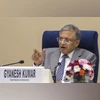 "Gyanesh Kumar, CEC")
EC officials said 533,093 booth-level officers (BLOs) will conduct the exercise with the help of 764,419 booth-level associates of political parties. | (Photo: PTI)
Listen to This Article
The Election Commission (EC) on Monday announced it would conduct the second phase of the Special Intensive Revision (SIR) of electoral rolls in 12 states and Union Territories (UTs), including four that are scheduled to hold Assembly elections by May 2026.
This phase will cover 510 million electors, more than half of the 970 million registered voters from the 2024 Lok Sabha elections. EC officials said 533,093 booth-level officers (BLOs) would carry out the exercise with the help of 764,419 booth-level associates (BLAs) of political parties.
These 12 include nine states (Chhattisgarh, Goa, Gujarat, Kerala, Madhya Pradesh, Rajasthan, Tamil Nadu, Uttar Pradesh and West Bengal) and three UTs (Andaman and Nicobar Islands, Lakshadweep, and Puducherry).
Among these, Tamil Nadu, Puducherry, Kerala, and West Bengal are due for Assembly polls by May 2026. In Assam, where elections are also due by May, a separate revision schedule will be announced, Chief Election Commissioner (CEC) Gyanesh Kumar said.
A separate provision of the Citizenship Act (section 6A) is applicable to Assam. Under the supervision of the Supreme Court, the exercise of checking citizenship is about to be completed (in Assam). The June 24 SIR order was for the entire country. Under such circumstances, this would not have applied to Assam, Kumar said.
Also Read

 "Mamata Banerjee, Mamata")
 "ECI, election commission of india, election commission")
The second phase of the SIR will begin on November 4 and continue until December 4. Draft electoral rolls will be released on December 9, and the final rolls published on February 7. The existing electoral rolls in these states and UTs were frozen with effect from midnight.
As evidence that it was a success, Kumar said the phase 1 of the SIR was concluded successfully in Bihar with “zero appeals”. EC sources said that compared to Phase 1 in Bihar, the list of documentary evidence required to be furnished has been reduced, and exemption extended to any relative of someone who was listed on 2002-04 rolls, and not just their parents. They said the EC would publish the list of excluded names. The BLAs appointed by political parties have been allowed to submit 50 enumeration forms a day.
The CEC said Aadhaar would be considered one of the optional documents for identity verification, but as the new Aadhaar cards mention, it is proof of identity, not domicile or citizenship.
Kumar said the law mandates that electoral rolls have to be revised before every election, or as per requirement. He pointed out that political parties have been raising issues relating to the “quality of rolls”. The CEC said SIRs had been conducted on eight occasions from 1951 till 2004, but the last SIR was done more than 21 years back in 2002-2004.
A countrywide SIR is needed as several changes in electoral rolls have occurred because of frequent migration, which has resulted in voters getting registered at more than one place, non-removal of deceased voters, and wrongful inclusion of any foreigners, the CEC said. He said the SIR would ensure no eligible elector is left out and no ineligible elector remains on the rolls.
The SIR will also ensure that no polling station has more than 1,200 electors. New polling stations will be created in high-rise buildings, residential welfare association (RWA) colonies, and slum clusters. Special care will be taken to ensure all members of a family are assigned to the same polling station, Kumar said.
The CEC ruled out any confrontation with the West Bengal government, where the ruling Trinamool Congress has expressed reservations about the SIR exercise in the state. The CEC said state governments are bound to provide the necessary personnel to the EC for the preparation of electoral rolls and conduct of polls.
The EC has conducted two conferences with state chief electoral officers (CEOs) to firm up the SIR rollout roadmap. Several CEOs have already put the voter lists after their last SIR on their websites.
More From This Section
 "Amit Shah, Home Minister")
 "a")
 "Roasted and spiced Foxnuts (Phool Makhana) (Photo: Wikimedia Commons)")
 "Akhilesh Yadav, Akhilesh")
 "air pollution, AQI, Delhi smog, post-Diwali pollution")
Don't miss the most important news and views of the day. Get them on our Telegram channel
First Published: Oct 27 2025 | 8:12 PM IST