


China's rare-earth restrictions aim to beat US at its own game
China's move has rekindled tensions between the world's two largest economies, with President Trump threatening to increase already substantial tariffs on Chinese imports
 "US CHINA, TRADE WAR")
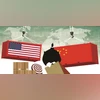
The Chinese government flexed its own influence over worldwide supply chains when it announced new rules clamping down on the flow of critical minerals that are used in everything from computer chips to cars to missiles. (Illustration: Binay Sinha)
Listen to This Article
Ana Swanson & Meaghan Tobin
Over the past three years, Washington has claimed broad power to impose global rules that bar companies anywhere in the world from sending cutting-edge computer chips or the tools needed to make them to China. American officials have argued that approach is necessary to make sure China does not gain the upper hand in the race for advanced artificial intelligence.
But a sweeping set of restrictions announced by Beijing last week showed that two can play that game.
The Chinese government flexed its own influence over worldwide supply chains when it announced new rules clamping down on the flow of critical minerals that are used in everything from computer chips to cars to missiles. The rules, which are set to take effect later this year, shocked foreign governments and businesses, which may now need to acquire licenses from Beijing to trade their products even outside China.
With its dominance over the production of these rare earth minerals and its control of other strategic industries, China may have an even greater ability than the US to weaponise supply chains, analysts say.
Also Read

 "Vladimir Putin, Putin")
 "Minister Israel Katz")
 "IMF")
 "earthquake")
“The US now has to face up to the fact it has an adversary which can threaten substantial parts of the US economy,” said Henry Farrell, a political scientist at the Johns Hopkins School of Advanced International Studies. The US and China are now very clearly “in a much more delicate stage of mutual interdependence,” he added. “China has really begun to figure out how to take a leaf from the US playbook and in a certain sense play that game better than the US is currently playing it,” Farrell said.
China’s move has rekindled tensions between the world’s two largest economies, with President Trump threatening to increase already substantial tariffs on Chinese imports by imposing an additional 100 percent tax on Nov 1 unless Beijing backs down from its new restrictions.
The type of supply chain restriction that China is embarking on first came into play in 2020. Washington dusted off an obscure provision known as the foreign direct product rule to target the Chinese tech giant Huawei, which the US government considered a national security threat. But instead of restricting American technology exports just to Huawei, the United States said any company anywhere in the world could not ship a product to Huawei if it contained U.S. parts or was made with U.S. equipment or software.
Because of the United States’ key role in the global chipmaking industry, the rules basically encompassed all advanced technology. It was a broad exertion of U.S. economic power that became the basis of a series of global tech rules during the Biden administration. Although foreign governments chafed at being told what to do, many cooperated for fear of being cut off from US technology.
The question now is: Will the Chinese restrictions persuade the Trump administration to walk back its tariffs or longstanding technology restrictions, or will China’s government fold under pressure first?
The administration seemed caught off guard by China’s restrictions, which could cripple American industries. Trump threatened on Friday to cancel a planned meeting with the Chinese leader, Xi Jinping, as well as adding a 100 percent tariff. After stock markets plunged, the president posted on social media on Sunday, “Don’t worry about China, it will all be fine!”
On Tuesday, Trump renewed his barbs, telling a crowd of reporters and the president of Argentina that Xi “gets testy because China likes to take advantage of people and they can’t take advantage of us.” On Wednesday morning, Treasury Secretary Scott Bessent and Jamieson Greer, the US trade representative, described the Chinese licensing system as a global power grab and said the United States stood ready to impose its tariffs if China moved forward.
“Our expectation is that this never goes into effect,” Greer said. Chinese officials have long criticized America's extraterritorial enforcement of economic measures and insisted that Beijing has acted with consistency in the face of renewed threats from Washington.
More From This Section
 "tsmc")
 "Nestle")
 "Donald Trump, Trump")
 "airports, passengers")
 "Donald Trump, Trump")
Topics : World News China US trade Trade talks
Don't miss the most important news and views of the day. Get them on our Telegram channel
First Published: Oct 17 2025 | 12:01 AM IST