


India hit with 50% tariffs: How countries are reacting to Trump's trade war
India slammed Trump's 50% tariff as unjustified; Canada, Brazil, and China also face new US trade actions, prompting strong backlash, WTO threats, and fresh retaliation
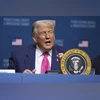 "Donald Trump, Trump")
US President Donald Trump (Photo/PTI)


Listen to This Article
Tensions between Washington and New Delhi have sharply escalated after US President Donald Trump announced a 50 per cent reciprocal tariff on nearly all Indian exports. The move, revealed in early August, targets India’s continued imports of Russian crude oil — a long-standing point of friction.
Why it matters
• The tariff affects almost $87 billion worth of Indian exports, including textiles, gems, and auto parts — making it one of the highest US tariffs on any major trading partner.
• It comes amid broader US efforts to pressure countries to reduce ties with Moscow, particularly in energy trade.
• India’s sharp rebuke has added fuel to a global debate over trade, sovereignty, and sanctions policy.
India hits back
India reacted strongly to Trump’s decision, calling it “unfair, unjustified and unreasonable.”
Also Read

 "DIIs, FPIs, NSE-listed firms, March 2025 shareholding, Prime Database, mutual funds ownership, insurance companies investment, foreign investors, domestic equity market, Indian stock market")
 "cars, auto industry")
 "exporters, trade, tariff")
 "BSE, stock market, sensex")
 "cars, toyota")
• The Ministry of External Affairs (MEA) said India’s Russian oil purchases are driven by market forces and national energy needs, not politics.
• “It is therefore extremely unfortunate that the US should choose to impose additional tariffs on India for actions that several other countries are also taking in their own national interest,” the MEA said.
• India also reminded Washington that Europe continues to import more oil from Russia, and that the US itself had encouraged Indian purchases early in the war to stabilise energy markets.
• “Like any major economy, India will take all necessary measures to safeguard its national interests and economic security,” the MEA added.
Global fallout: How other nations responded
Canada
• From August 7, Canadian goods not covered under USMCA will face a 35 per cent tariff, up from 25 per cent.
• A new 40 per cent levy applies to Canadian goods routed through third countries to avoid the tariff.
• The US cited Canada’s “inaction” on opioids and retaliatory trade moves as reasons.
Canadian Prime Minister Mark Carney said he would talk to Trump “when it makes sense”, adding, “Without an agreement, there will be less by definition.”
Brazil
• President Luiz Inácio Lula da Silva rejected Trump’s offer for a phone call, saying he would rather speak with Indian Prime Minister Narendra Modi or Chinese President Xi Jinping.
• Lula vowed to use the World Trade Organization (WTO) and other avenues to fight the 50 per cent US tariff imposed on Brazil. “I will call Xi Jinping, I will call Prime Minister Modi… I won’t call Putin, because he can’t travel now,” Lula said. “In 2025, we will resort to all possible measures… to defend our interests.”
• The US claims the Brazil tariff is a response to what Trump calls a “witch hunt” against former President Bolsonaro, who faces coup-related charges in Brazil.
China
• Trump hinted at possible secondary sanctions on China during a White House press briefing. “It’s only been eight hours. So let’s see what happens… You’re going to see so much secondary sanctions,” he said. When asked whether China could be next, Trump replied: “Could happen. Depends on how we do. Could happen.”
• In retaliation, China imposed new 10–15 per cent tariffs on US agricultural and dairy goods and restricted rare earth exports. If no deal is reached by August 12, tariffs could rise back to 34 per cent.
• Former UN ambassador Nikki Haley criticised Trump for being lenient with China while punishing India. “Don’t give China a pass and burn a relationship with a strong ally like India,” Haley said.
Trump tariffs: Countries that cut deals
Japan
• Secured a uniform 15 per cent tariff rate on most goods, avoiding Trump’s initial threat of 25 per cent.
• Steel and aluminium remain exceptions, with 50 per cent tariffs still in place.
• In return, Japan agreed to invest $550 billion in the US, especially in energy and tech.
European Union
• High-tariff goods: No added duties
• Low-tariff goods: Capped at 15 per cent, minus existing rates
• The EU pledged $600 billion in US investments and increased energy and defence purchases.
• But Trump warned: If the EU fails to deliver on its investment pledge, a 35 per cent blanket tariff could be imposed.
The big picture
Trump’s sweeping tariff actions are reshaping global trade dynamics, forcing countries to choose between Washington’s economic agenda and their own strategic interests. While some allies like Japan and the EU have opted for quick negotiations, others — notably India and Brazil — are digging in, defending their economic sovereignty and questioning Washington’s approach.
(With agency inputs)
More From This Section
 "Harvard University")
 "White House")
 "Switzerland")
 "Donald Trump")
 "University of California")
Topics : Donald Trump Trump tariffs US India relations US-Canada Brazil Japan US China trade war US China Ministry of External Affairs MEA BS Web Reports Explained
Don't miss the most important news and views of the day. Get them on our Telegram channel
First Published: Aug 07 2025 | 1:17 PM IST