


Musk-Trump feud threatens billions in SpaceX deals, risks US space goals
Escalating tensions between Elon Musk and Donald Trump raise concerns about the stability of SpaceX's contracts with Nasa and the Pentagon, vital to US space and defence
 "Donald Trump, Trump, Elon Musk")
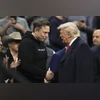
The flare-up is the latest in a continuing feud that began after Musk stepped down from a short-term role leading the Trump administration’s Department of Government Efficiency (DOGE). (Photo: PTI)
Listen to This Article
Elon Musk and Donald Trump’s spat on Thursday has escalated from online exchanges to potential real-world consequences, threatening a key part of the US space programme. After Trump threatened to cancel all federal contracts with Musk, putting a significant source of revenue for SpaceX at risk, Musk said that he would decommission SpaceX’s Dragon spacecraft, which ferries cargo and astronauts to the International Space Station for the US. However, he later appeared to back down, reported Bloomberg.
SpaceX, the world’s leading rocket launcher, also holds lucrative contracts with the Pentagon to launch national security satellites and is developing a spacecraft aimed at landing American astronauts on the Moon within two years.
The flare-up is the latest in a continuing feud that began after Musk stepped down from a short-term role leading the Trump administration’s Department of Government Efficiency (DOGE) and criticised key elements of Trump’s presidency, including tax reforms and trade tariffs.
While Musk voiced his criticism on his social media platform X, Trump fired back during a meeting with the German Chancellor and through posts on his own site, Truth Social. However, the question remains whether either will carry out their threats.
Also Read

 "Rajnath Singh")
 "Air India Express, Air India, Boeing")
 "Putin, Trump")
 "Lt Gen Rahul R Singh")
 "A complete Indian bid for $7-bn LNG tender")
SpaceX’s critical role in US space and defence
The Bloomberg report quoted a senior fellow at the Centre for Strategic and International Studies, saying that cutting contracts with SpaceX would trigger a domino effect across many critical US government functions, especially within the Pentagon and Nasa. “Right now, no other company can match what SpaceX provides,” he said.
SpaceX, valued at around $350 billion and one of the world’s most valuable start-ups, has secured over $22 billion in unclassified contracts from the Department of Defense and Nasa since 2000.
Nasa awarded SpaceX nearly $4 billion to help land US astronauts on the Moon. The agency’s dependence on SpaceX’s Dragon spacecraft for missions to the International Space Station has increased, particularly due to delays with Boeing’s Starliner programme. SpaceX also holds an $843 million contract to safely decommission the ISS at the end of its mission. Earlier this week, Musk revealed that SpaceX earned approximately $1.1 billion from Nasa contracts in 2025 alone.
According to the report, a Nasa spokesperson stated that the agency will continue to pursue the President’s space goals and work with industry partners to achieve those objectives.
SpaceX’s Starlink satellite internet service, which provides broadband access to rural areas and holds contracts with the Pentagon, could also face jeopardy.
According to Peter Hays, a professorial lecturer at George Washington University’s Space Policy Institute, “Musk has launched more satellites than the rest of the world combined. It wouldn’t be simple to just cut ties with him.”
SpaceX, alongside Boeing, Lockheed Martin’s United Launch Alliance (ULA), and soon Blue Origin, plays a vital role in launching US national security missions, including surveillance satellites for the Pentagon. However, Blue Origin has only recently introduced its New Glenn rocket, and ULA is still struggling to increase its launch capacity, leaving the Space Force and the National Reconnaissance Office heavily reliant on SpaceX.
The report quoted Todd Harrison, a senior fellow at the American Enterprise Institute, saying, “They can’t really cut off SpaceX without having a severe impact on the military space capabilities.” According to Harrison, the conflict between Trump and Musk could affect the future of the Golden Dome missile defence system. If the administration decides to use a design less dependent on space technology, SpaceX might face fewer contract opportunities. “This dispute could influence the final design choices for the Golden Dome system,” he said.
Legal authority and challenges to contract cancellation
It remains uncertain whether Trump can unilaterally cancel contracts or revoke subsidies granted to SpaceX.
Contract awards and cancellations are meant to be free from political influence, and if the President acts on his threats, SpaceX could sue for breach of contract. Even if the administration tries to end the contract through standard procedures, the public statements by the President could provide grounds to challenge the termination.
Terminating federal contracts is both costly and politically sensitive. Most contracts include a “termination for convenience” clause, but exercising this often requires the government to compensate contractors for billions of dollars in lost expenses. Moreover, only designated contracting officers, not the President, have the legal authority to sign or cancel federal contracts, according to a Bloomberg report.
The report quoted Caryn Schenewerk, a space industry consultant and law professor at Georgetown University who formerly worked at SpaceX, stating, “You can’t just flip a switch. There are established procedures and responsibilities that must be followed to cancel contracts.”
Improper handling of contract cancellations could expose the government to further legal battles, especially given Musk’s history of litigation. In 2014, Musk sued the Air Force to allow SpaceX to compete for national security satellite launches but dropped the suit when the Air Force opened the contract to competition.
More From This Section
 "Israel strike")
 "immigration, visa, travel")
 "Harvard, Harvard University")
 "Donald Trump, Trump, Elon Musk")
 "Donald Trump, Trump")
Topics : Elon Musk Donald Trump BS Web Reports space
Don't miss the most important news and views of the day. Get them on our Telegram channel
First Published: Jun 06 2025 | 8:54 AM IST