


US-Israel attack on Iran: Why Trump is not calling it a 'war', yet
US President Trump calls the Iran strike a 'major combat operation' since only Congress can declare war, raising questions on what would change if it were approved
 "US President Donald Trump")
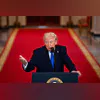
US President Donald Trump has termed the strikes in Iran as a
Listen to This Article
The United States and Israel launched a sweeping military campaign against Iran on Saturday, February 28, killing Supreme Leader Ayatollah Ali Khamenei and escalating a regional crisis that has already drawn Iranian retaliation.
Yet, even as the scale of action widens, the White House and its allies have been careful in how they describe it: not as a 'war', but as a military operation or campaign. That choice is political, and it is also shaped by the way US law splits war-making power between Congress and the President.
What did Trump say?
US President Donald Trump has termed the strikes in Iran as a "major combat operation" rather than a "war" despite it being an attack against a sovereign state.
Trump said the strikes are a "massive and ongoing" operation aimed at dismantling Iran’s military and nuclear capabilities.
Also Read

 "Modi, Narendra Modi")
 "IIP, index of industrial production, manufacturing, industrial production")
 "American jet down in Kuwait")
 "US Israel strike Iran")
 "restless leg syndrome")
How war and strikes are different under the US Constitution
According to Article I of the US Constitution, Congress has the power to declare war, while the President is Commander-in-Chief of the armed forces.
In practice, that has produced a long-running dispute between the legislative and executive branches over who can initiate hostilities, and when. Congress codified its position in the 1973 War Powers Resolution, saying US forces should be introduced into hostilities only after Congress has declared war, authorised force, or in a national emergency created by an attack on the US or its territories.
At the same time, the executive branch has repeatedly argued that not every use of force is 'war' in the constitutional sense, drawing a line between limited military action and 'full-scale war' that would require Congress. That gap is where US presidents operate when they order airstrikes without seeking a formal authorisation.
David Janovsky, acting director of The Constitution Project at the Project on Government Oversight, told TIME that a president’s unilateral authority is confined to genuine emergency situations such as when an attack is already underway and must be repelled, or when there is a clearly imminent threat.
Since the Congress has not yet authorised a war and that there has been no indication of any direct attack on the US, Janovsky described the current strikes as "illegal". Therefore, in order for Trump to call it a "war", he needs to take it to Congress and get it approved.
According to House of Representatives Speaker Mike Johnson, a Republican, the Trump administration informed the “Gang of 8”, a bipartisan group of congressional leaders, before carrying out the strikes, reported BBC.
Why is Trump not taking it to Congress?
Trump hasn't taken the current conflict to Congress possibly because it has the authority to restrict funding for military action and can introduce a War Powers Resolution (WPR) to block or limit the President’s use of force. The WPR, which was first adopted in 1973 when the US was engaged in the Vietnam war, establishes presidential reporting requirements and parliamentary procedures intended to reaffirm the constitutional role of Congress in committing the US into armed conflict abroad.
It states that before the President deploys US troops into hostilities overseas, Congress should be consulted "in every possible instance". It also requires the President to report to Congress within 48 hours of introducing US forces where war has not been declared. Furthermore, if congressional approval is not obtained, the operation must end within 60 days unless Congress authorises it.
Democrats have criticised the current action and have called for the introduction of a WPR. However, the odds of such a bill passing appear unlikely for now.
Has this happened before?
Yes. Earlier this year, under Trump's administration, the US military launched an operation in Venezuela, capturing its President Nicolás Maduro. Similarly, last year, Trump said that the US military launched a strike targeting nuclear facilities in Iran. Both of these were done without Congressional approval.
Not just Trump, former US presidents from Harry Truman to Barack Obama ordered US troops into combat without formal declarations of war or approval of Congress in nations such as Iran, Panama and Libya.
Points of contention remain
None of this resolves the central dispute: at what point do sustained strikes, widening targets, and escalating retaliation amount to war in fact, even without a formal declaration.
According to Constitution Annotated, which analyses and interprets US Constitution, courts have generally avoided settling modern war-powers clashes, often dismissing cases on justiciability grounds such as standing or the political question doctrine — leaving the conflict to be contested in politics, not courts.
More From This Section
 "oil tankers, sea shore, trading")
 "Iran, US Israel attacks on Iran, Israel Iran conflict, US Iran, Israel Iran")
 "Iran, US Iran, Israel Iran, LNG, Strait of Hormuz")
 "Saudi Aramco, oil refinery")
Topics : US Iran tensions Israel Iran Conflict US Congress US Military military power BS Web Reports
Don't miss the most important news and views of the day. Get them on our Telegram channel
First Published: Mar 02 2026 | 5:25 PM IST