


India can soon wean itself off GPS
The country to launch first of it's 7 navigation satellites
)
India's bid to join the most elite of clubs of navigation satellite-owning nations will see a first big step being taken tonight with the first of the seven satellites being launched at 11.45 pm today.
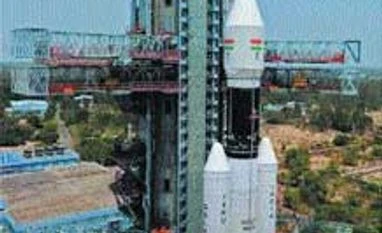
The rocket that will deliver the country's first navigation satellite at midnight is being readied for its mission with its second stage getting fuelled at Sriharikota, a senior official at the Indian Space Research Organisation (Isro) said.
"The mission will be as per schedule. The countdown is progressing well and the filling of the liquid fuel for the second stage is going on fine. The weather is good and we do not see any hitch in the mission," the official at Isro said.

The 64.5 hour countdown began at 7.11 am on Saturday. The Polar Satellite Launch Vehicle-XL (PSLV-XL) which is 44 metres tall, will weigh 320 tonnes at lift-off. The four-stage rocket will alternatively be powered by solid and liquid propellants.
The solid fuel hydroxyl-terminated-poly-butadiene comes cast while the liquid fuel, an unsymmetrical dimethyl-hydrazine-hydrate and 25 per cent of nitrogen tetroxide for second stage and mono-methyl-hydrazine and mixed oxide nitrogen for fourth stage -- are filled during the countdown.
Around 20 minutes after launch, the PSLV-XL will eject the 1,425 kg IRNSS-1A (Indian Regional Navigation Satellite System-1A) at an altitude of 501 km.
The satellite is intended to provide terrestrial, aerial and marine navigation services and help in disaster management. The system is similar to the global satellite positioning (GPS) of the US and the GLONASS of Russia.
"But, the IRNSS has better accuracy and it is better that India doesn't depend too much on the GPS or GLONASS. They can be switched off as and when they want," said U R Rao, a former chairman of the Isro. It carries 'corner cubes' that are valuable in applications where it's difficult or time-consuming to attain precision alignment.
The satellite, with a lifespan of around 10 years, is one of the seven satellites that make up the IRNSS system developed by India. "It is designed to provide accurate positional information service to users in the country and up to 1,500 km from India's boundary, Isro said.
The entire IRNSS system is expected to be in place by 2014 and the project is expected to cost around Rs 1,420 crore.
The service area can be expanded by adding more satellites, Isro officials said.
The IRNSS will provide two types of services - standard positioning service and restricted service. The former is provided to all users and the later is an encrypted service for authorised users.
Don't miss the most important news and views of the day. Get them on our Telegram channel
First Published: Jul 01 2013 | 6:52 PM IST