


WSJ report on payment may have delayed signing of Boeing deal
)
A Wall Street Journal (WSJ) report on questionable payments made by American companies might have caused a three-day delay in communicating a Cabinet decision approving the purchase of three Boeing aircraft to the Indian Airlines' management in February 1977.
On February 5, 1977, the Cabinet of then Prime Minister Indira Gandhi approved the purchase of three Boeing 737 aircraft for Rs 30.55 crore, swiftly bringing to a close the deal in less than nine months of setting up a committee to recommend how the fleet capacity of Indian Airlines should be augmented.
These nine months saw several controversies around the exercise, including a meeting in the room of Indian Airlines' acting chairman A H Mehta, where "Indira Gandhi's son", Rajiv Gandhi (who was then an Avro commander with the airline), was ushered in and shown some "financial projections", a procedure the J C Shah Commission later found "totally outside the ordinary course of business". The Shah commission that probed excesses of the Emergency years (1975-77) also brought out how the Boeing deal was pushed by Indira Gandhi and rushed through after overruling the recommendations of the Planning Commission and the Public Investment Board.

However, soon after the Cabinet's approval of the Boeing deal, Indira Gandhi had told the then civil aviation and tourism minister,
K Raghuramaiah, about a WSJ report and advised him to wait before the purchase order was placed. On February 8, Indira Gandhi told Raghuramaiah to "go ahead" and "place the order". The minister did just that: He informed the IA management about the Cabinet approval and the contract with Boeing was signed on February 9, 1977. (Please see Business Standard's April 18 report: "Controversial Boeing Deal of 1976-77: Rajiv Gandhi met IA brass, was shown financial details against norms", http://goo.gl/95yZI)
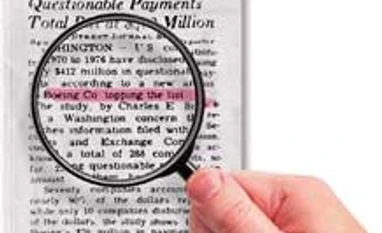
A Business Standard investigation into what precisely led to the delay reveals that Indira Gandhi might have become cautious after the publication of the WSJ report in January 1977 referring to questionable payments made by US companies, including Boeing. On January 21, 1977, WSJ carried a report headlined "Questionable Payments Total Put at $412 Million". It mentioned Boeing as "topping the list" of 288 companies which had made questionable payments.
Quoting a study by a Washington concern, Charles E Simon and Co, the news report went on to state that Boeing had admitted to making payments of $70 million. The details were collated from information filed by the companies with the Securities and Exchange Commission. The list, according to the WSJ report, included other prominent American corporations (with the payment amounts in brackets): Exxon Corp ($46 million), Northrop Corp ($32 million), Lockheed Aircraft Corp ($25 million) and Armco Steel ($17.5 million). The report also carried a disclaimer that the summary of payments included commissions, agent fees, over-billings and other payments, "many of which may not be deemed improper".
Indira Gandhi's caution over concluding the deal was understandable. The final go-ahead for signing the contract might have been given only after ensuring that nothing specifically controversial about the deal appeared in any foreign newspaper. Domestic politics might have also prompted the hasty decisions that drove the deal.
A couple of weeks before her Cabinet cleared the Boeing purchase proposal, she had called for fresh elections, scheduled to be held in March 1977. But just three days before the deal was approved on February 5, senior minister Babu Jagjivan Ram had resigned, adding to the rumbling of protests against her Emergency regime. The WSJ, in its report on February 7, noted: "Premier Gandhi was shaken last week by the resignation of a senior Cabinet minister ...".
The report also recorded the massive rally on Sunday, February 6, at Ramlila Maidan in Delhi by the newly formed Janata alliance, challenging Gandhi's authority and the Emergency. The item was titled "Indira Gandhi's Opponents Denounced her at a Huge Campaign Rally." The news report recorded the "massive display of anti-government sentiment where two lakh people cheered the Opposition politicians attempting to unseat Premier Gandhi at next month's election." Was Sanjay Gandhi also interested in the aircraft deal?
Another curious aspect of the controversial Boeing deal pushed through by Indira Gandhi's government in 1976-77 is brought out by the Kissinger Cables made public by WikiLeaks. One of the diplomatic messages from the US embassy during that period mentions an Indian Airlines purchase deal and the airline's keenness to acquire aircraft for its "pressing twin jet requirements". The cable, 1976NEWDE11152_b sent on July 30, 1976, from the American Embassy in New Delhi, stated: "Sanjay Gandhi, who has interests in Maruti, is negotiating for a BAC (British Aircraft Corporation) agency in India." The cable stated that BAC was in contention with its 111-475 twin-jet aircraft and the Dutch with their Fokker-F 27. "Both British and Dutch governments have supported sales of their aircraft," the cable went on to state.
The cable noted: "Political considerations are always of importance in aircraft sales …." Indian Airlines Director-Finance Kirpal Chand (who also testified before the Shah commission regarding the decision to purchase Boeing aircraft) is repeatedly mentioned in the US cable as being one of those who, along with Indian Airlines chief A H Mehta and Planning Manager J K Chaudhuri, are members of the Aircraft Selection Committee and will be taking the decision on new twin-jets for the airline.
Going by the Kissinger Cables and the Shah commission report, it appears both Rajiv Gandhi and Sanjay Gandhi had shown some interest in the Indian Airlines deal for new aircraft.
Don't miss the most important news and views of the day. Get them on our Telegram channel
First Published: Apr 20 2013 | 12:56 AM IST