


Government sees fertile ground on agrarian reform
Uncertainties and resultant risks in agriculture arise primarily because of vagaries of nature and iniquitous marketing
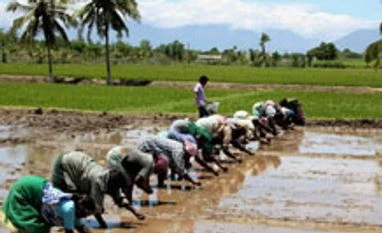)
"It is the one key touchstone that India's performance will be judged by." So began Arun Jaitley, the finance minister, at the inauguration of the Foundation Day Seminar on mitigating of the agrarian distress and enhancing farm incomes, organised by the National Bank for Agriculture and Rural Development (Nabard) in Mumbai on Sunday. He said even as there were many encouraging developments on the economic front, for example, India's growth being especially noteworthy in the light of the depressed global conditions, India has to both grow rapidly and ensure its gains are distributed equitably.
There is no gainsaying that agrarian distress has become contagious. Ever greater numbers of farmers have become increasingly vulnerable to even small variations in climatic conditions, as happened earlier in the year due to hail and rain. Abhimanyu Singh, the Haryana finance minister, attributed this in large measure to an urban mindset that produces a policy environment not conducive to promoting agriculture. Ashok Gulati, an agricultural economist, agreed and said that the straitjacket policies prior to the 1990s led to effectively taxing agriculture through unrealistic exchange rates and excessive protection to industry.
Uncertainties and resultant risks in agriculture arise primarily because of vagaries of nature and iniquitous marketing. Jaitley drew attention to the recent government announcement of setting aside Rs 50,000 crore for the Pradhan Mantri Krishi Sinchai Yojana for the next five years. He was optimistic that the present signs of economic upturn would add to government revenues in the years to come and committed that the first claim on these added funds would be of agriculture.

The seminar panelists stressed that efficient use of available water was as important as provision of greater irrigation, if not more so. Paddy is grown in Punjab and Haryana under conditions that result in substantial wastage of water and energy. Exporting surplus rice is tantamount to exporting quantities of precious water 4,000 to 6,000 times as large. A shift to other crops, such as pulses, oilseeds and maize, all of which use water more economically and result in either saving imports or actual exports, might be more appropriate, even as a second Green Revolution is contemplated for eastern India.
Shifting away from conventional field crops to seasonal or perennial horticulture and tree crops could spread the risk and ensure some incomes even under adverse climatic conditions. Animal husbandry has already been successful in de-risking agriculture in many parts of the country. All of these concerns imply a shift away from mere production to generating regular and reliable incomes and affording farmers a semblance of security.
The government has also plans to integrate 585 wholesale markets across the country and bring online, Jaitley added. Single-point entry and registration, along with access to price data, were proposed. Rs 200 crore have been allocated for this purpose in the next two years. While by itself no panacea for the myriad problems that affect marketing of agriculture produce, the integration and digitisation of marketing information could lead to improved price discovery. In a similar way, farmers associated with e-choupals in Madhya Pradesh have reported their knowledge of market conditions is better.
Yet the problem of cash needs immediately following harvests could prevent farmers from maximising gains. The suggestion of negotiable warehouse receipts has made little impact. At the same time, political interests which exercise an iron grip on produce markets in some commodities and states, would not simply keel over. Reforming agricultural marketing is essentially a test of the political will. But Gulati pointed out that politics and rational decisions can go together. Farmers of Gujarat, Madhya Pradesh and Chhattisgarh were largely instrumental in re-electing reform-minded chief ministers several times, in view of the signal growth of agriculture the states had experienced.
Evolving realistic insurance schemes appropriate for Indian conditions is also under government consideration, according to Jaitley. That could help improve the penetration of insurance to levels higher than the present single-digit percentages. Such schemes need to cover a part of income loss in addition to input costs and would have to be underwritten by the government. But that cost would be greatly offset by the relief they would provide to the beneficiaries.
In the final analysis, the best way to mitigate distress is to reduce the extent and impact of factors causing distress in the first place. That is possible only in the long haul. But even if there are no quick fixes, it was heartening to see a serious discussion of the subject as evidenced by the well-attended and keenly followed Nabard seminar.
The writer was a panelist at the seminar. He taught at Indian Institute of Management, Ahmedabad, and helped set up Institute of Rural Management, Anand
Don't miss the most important news and views of the day. Get them on our Telegram channel
First Published: Jul 13 2015 | 12:34 AM IST