


Road to Delhi in 2019 goes via UP 2017: Narendra Modi
PM says people not satisfied with mere slogans; party resolution of "prosperous villages - developed India"
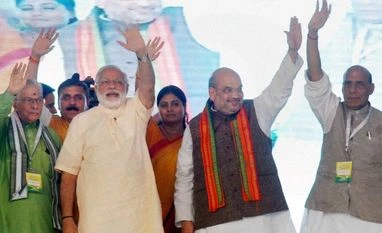 "Prime Minister Narendra Modi with Union Minister Rjanath Singh, BJP President Amit Shah and other senior leaders during 'Parivartan Rally' at Parade Ground in Allahabad")
Prime Minister Narendra Modi with Union Minister Rjanath Singh, BJP President Amit Shah and other senior leaders during 'Parivartan Rally' at Parade Ground in Allahabad
The Bharatiya Janata Party (BJP) is yet to resolve its confusion on who would be its chief ministerial candidate for the Uttar Pradesh assembly polls and whether at all it should announce one. But the aggression in Prime Minister Narendra Modi and party chief Amit Shah’s speeches at a public rally here underscored the importance of a good performance by the BJP in UP elections, slated for early 2017, if Modi is to return as the prime minister in 2019.
Both Modi and Shah appealed to the people of UP to reject the nepotism, casteism and lawlessness wrought by Samajwadi Party and Bahujan Samaj Party, who were hand in glove on each other’s corruption. Modi credited the people of UP for enabling BJP reach majority mark in 2014 Lok Sabha and that the state has given India several of its prime ministers. BJP, along with its ally Apna Dal, had won 73 of UP’s 80 seats in 2014. Shah was more direct. “The road to Delhi goes via Lucknow. BJP forming a government in the state in 2017 will pave Modi’s way to Delhi in 2019,” he said.
While Modi stayed away from the more contentious issues and promised development to the youth of the state and to its farmers, Shah raked up alleged exodus of Hindus from Kairana in western UP. Party sources said the party leadership hasn’t taken kindly to supporters of its Sultanpur Lok Sabha member Varun Gandhi having plastered the city with posters and erecting hoardings of him as the chief ministerial candidate for UP polls.
Earlier in the day, the PM also spoke at the concluding day of the BJP’s national executive meeting which passed two resolutions – a political resolution on Modi government’s people friendly policies and another on its recent electoral achievements in Assam and Kerala. He told the party executive, which comprises nearly 120 of its topmost leaders from across the country, that people aren’t satisfied with mere slogans but wanted to see policies and actions that make India a stronger nation.
He noted that BJP has reached the zenith of its geographical expansion and the height of its popularity and gave party cadres a seven point talisman, which they should follow in their personal conduct and while devising policies of the party. The PM asked party cadres to have - sevabhaav (sense of service); santulan (balance); sanyam (patience); samanwaya (coordination); sakaratmak (positivity); samvedna (empathy) and samvaad (dialogue). When asked about the provocation behind the PM's seven-point talisman, Finance Minister Arun Jaitley said politicians make well considered statements and not because of any provocation. The PM also said India’s was a rare instance where a country has got a second chance at joining the industrial revolution after having let slip the opportunity in the past, and it should make the most of it to become a world power in the years to come.

The political resolution lauded as well as detailed Modi government’s poor and farmer friendly policies and stated its vision was that of “prosperous villages – developed India”. It also talked about its policies to empower women, Dalits and tribal people and mentioned twice how it has recognized the contribution of BR Ambedkar. On the reform front, it pointed at the setting up of the Bank Board Bureau has been established to stop any political or private interference in the Bank’s working and passage of the bankruptcy law.
The executive had passed the economic resolution on Sunday. Today, it also passed a resolution to express its “gratitude” to the PM and Shah for their leadership that won BJP Assam – the gateway to the northeast – and improved showing in Kerala. The resolution said “BJP is the party of Bharat’s present and it will be the party of its future.” It said the BJP will work to strengthen itself in the states of Bengal, Odisha, Andhra Pradesh, Telangana, Tamil Nadu and Kerala.
It noted that BJP is today the only pan-Indian party and the Congress is shrinking by the day.
Don't miss the most important news and views of the day. Get them on our Telegram channel
First Published: Jun 13 2016 | 9:28 PM IST