


Why western UP could help BJP repeat its LS 2014 results in UP election
Party wooing dominant Jat community of western UP and peasants among non-Yadav backward castes and non-Jatav Dalits
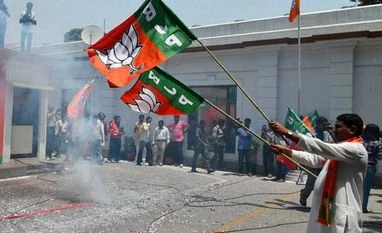 "BJP workers celebrate party victory in Assam 2016 polls")
BJP workers celebrate party victory in Assam 2016 polls
The Bharatiya Janata Party (BJP) leadership had brainstormed for days before it picked Saharanpur, the sugar bowl of Uttar Pradesh, to mark two year celebrations of Narendra Modi government at the Centre.
The PM's rally, with Home Minister and former Uttar Pradesh Chief Minister Rajnath Singh by his side, was held with one eye on the UP assembly polls slated for early 2017. Both Modi and Singh sent a message to not just the influential sugarcane farmers of western Uttar Pradesh but farmers across the country that the Modi government is committed to their welfare.
The assessment of party president Amit Shah and his close advisers is that Modi's public rally in Saharanpur achieved its objectives. The 'Modi, Modi' chants were back and the response to the rally, particularly among the youth of the region, was evidence that brand Modi remains intact.
Secondly, it invigorated a demoralised state leadership to become battle ready. The public response told them that BJP could emerge the single largest party in the UP assembly polls. The rally ground had posters that declared BJP's mission of winning 265 plus of the 403 seats.
The BJP, with its focus on farmers, is trying to woo the dominant Jat community of western UP and also the peasants among non-Yadav backward castes and non-Jatav Dalits. BJP's local Jat leader Sanjeev Balyan, a Lok Sabha Member of Parliament from neighbouring Muzaffarnagar and union minister of state for agriculture, led the preparations for the public rally.

BJP leaders dispute that Saharanpur was the launch of the party's UP poll campaign, but don't deny that the choice had as much to showcase the government's pro-farmer steps as to underline its efforts to reduce the stress on sugarcane farmers of the region. "UP is an important state. It needs deliverance from the poor governance that the cocktail of Samajwadi Party, Bahajun Samaj Party and Rashtriya Lok Dal have unleashed in the past 15 years. Law and order has collapsed. Condition of power and water supply and roads is abysmal," Sharma says. BJP's last government in UP was in 2002 with Rajnath Singh as the chief minister.
Sharma points to several steps from from crop insurance to irrigation scheme launched by the PM. But the Modi government has taken series of steps specifically to bring succour to sugarcane growers and sugar industry of Uttar Pradesh.
There are nearly 120 sugar mills in UP. More than 40 per cent of which are located in western UP, this also makes it the largest organised industry in the whole state. UP is India's second largest sugar producing state in the country and home to some of biggest names in India's sugar sector - Bajaj Hindustan, Balrampur Chini Mills, Dhampur Sugar, etc.
In a year, typically the cane price payable to farmers is in the range of Rs 60,000 - 65,000 crore. In 2014, when the National Democratic Alliance government took over, the sugar industry was faced with crisis of arrears of cane payments. The cane arrears have been brought down from Rs 14,000 crore to Rs 780 crore, with arrears in UP reduced to Rs 191 crore. The Centre also came up with a new policy of direct payment of cane dues to farmers and one year moratorium on interest on soft loans, which also provided support to the sugar industry.
The Centre also introduced a modified Ethanol Blending Programme to achieve up to 10 per cent blending levels with Motor Spirit to help the sugar industry. In the year 2013-14, ethanol supplied for blending was only 38crL. In 2014-15, under the modified EBP, supply increased to 67crL and is expected to have reached 130 crL in 2015-16.
As for political symbolism of the place, Saharanpur is the 'number one' of the 80 parliamentary constituencies of UP and also assembly constituencies in the area are the first few numbers of the 403 assembly constituencies of the state. It was the BJP's influence in western UP after mid-2013 that had helped it win as many as 73 seats, including two of its ally Apna Dal, across UP in 2014 Lok Sabha polls.
In August 2013, Muzaffarnagar had witnessed communal riots. Its political opponents had accused the BJP then, as they have now, of electorally benefitting from communal polarisation. "Such allegations expose the frustration of the SP and BSP. It is their attempt to cloak their failures. We won't let them succeed. We will contest the UP elections on the issue of governance and development," Sharma said.
Don't miss the most important news and views of the day. Get them on our Telegram channel
First Published: Jun 03 2016 | 6:12 PM IST