


Forex reserves close to all-time high
The forex kitty up $2.71 billion to $320.56 billion
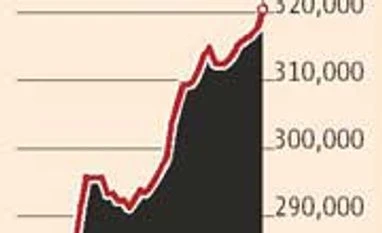)
The country’s foreign exchange reserves are merely $23 million away from its all-time high on September 2, 2011, when it touched $320.79 billion.
The reserves were $320.56 bn as on July 25, an increase of $2.7 bn in one week, on the back of heavy dollar buying by the Reserve Bank of India in recent months as foreign investments poured in due to improved sentiment.
“Movements in the foreign currency assets occur mainly on account of purchases and sales of foreign exchange by RBI in the foreign exchange market, income arising out of the deployment of the reserves, external aid receipts of the central government and the effects of revaluation of the assets,” the central bank said in its 'Half-yearly report on management of foreign exchange reserves', issued on Friday. The report referred to the period September 2013 to March 2014.
Between March and May, the central bank purchased about $15 bn from the spot segment of the forex market.
“We expect (RBI) Governor (Raghuram) Rajan to continue to recoup FX to guard against contagion. After all, RBI needs to raise $80 bn to maintain the current not-very-adequate import cover at eight months by March 2016,” said Bank of America Merrill Lynch in a note to its clients.
The report quotes International Monetary Fund data which showed RBI bought $9 bn of forwards during June, after buying $19 bn in May.
The central bank has been able to recoup its forex reserves, which hit $274.8 bn in the week ended September 6 last year, amid a currency crisis that saw the rupee hit its lowest ever level on August 28, 2013 when it closed at 68.83 to a dollar. That prompted RBI to announce a number of measures to attract foreign currency inflows, to stabilise the rupee.
The currency has risen 11 per cent since its August lows. Inflows worth $34 bn came via the twin swap windows for FCNR(B) funds and banks' overseas borrowings. RBI said the increase in reserves helped to raise the import cover to 7.8 months as on March-end, from 6.6 months as on end-September.
“RBI has been buying dollars because they wanted the reserves to pick up. In my view, it is good if there a bit of volatility in the market. If there is none, people do not hedge. That is probably their thinking as well, so they are letting the rupee weaken. RBI has got reserves to stop the weakness if they want to. But probably they do not want to and that is a good thing,” said Jamal Mecklai, chief executive, Mecklai Financial Services.
With sentiment turning positive from earlier this year on the expectation of a pro-reform government taking charge at the Centre, foreign investors also poured funds in both Indian equities and debt papers that helped foreign exchange to swell. Since January, foreign investors have put $26 bn in equities and debt.
The level of reserves will calm the markets, after the rupee breached the 61 a dollar mark for the first time in four months on Friday, to close at 61.19/$. “The market does not need to panic because RBI has got strong reserves. RBI is now better placed to intervene if the rupee weakens significantly. Today, too, there was little intervention by RBI. We might again see intervention if the rupee breaches the 61.50 mark,” said the treasury head of a public sector bank.

Don't miss the most important news and views of the day. Get them on our Telegram channel
First Published: Aug 02 2014 | 12:35 AM IST