


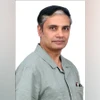
 "Subhomoy Bhattacharjee")
Subhomoy Bhattacharjee
Subhomoy Bhattacharjee
Subhomoy Bhattacharjee is an author and contributing editor to Business Standard. He works on public policy, primarily finance, maritime, and energy issues. He writes on current economic issues at On Point with Subhomoy Bhattacharjee. He is also a Professor of Practice and director, Centre for Regulatory Governance at Jindal Global Law School at the OP Jindal Global University. He has degrees in economics from the Delhi School of Economics and the Shri Ram College of Commerce. He has worked in the Indian government as part of the Indian Information Service. He has also written for the Economic Times, Indian Express, and Financial Express newspapers.
Subhomoy Bhattacharjee is an author and contributing editor to Business Standard. He works on public policy, primarily finance, maritime, and energy issues. He writes on current economic issues at On Point with Subhomoy Bhattacharjee. He is also a Professor of Practice and director, Centre for Regulatory Governance at Jindal Global Law School at the OP Jindal Global University. He has degrees in economics from the Delhi School of Economics and the Shri Ram College of Commerce. He has worked in the Indian government as part of the Indian Information Service. He has also written for the Economic Times, Indian Express, and Financial Express newspapers.


Page 13 - Subhomoy Bhattacharjee
Ministry of Corporate Affairs improves the ease of running a company
Over the past two years the government has moved to decriminalise key provisions and simplified statutory requirements in the Companies Act

 "Ministry of Corporate Affairs improves the ease of running a company")
Industry-friendly moves keep Gujarat ahead in investor perceptions
Gujarat gains because it was the first to check all the boxes as far as investor-friendly policies are concerned
 "Industry-friendly moves keep Gujarat ahead in investor perceptions")
Democracy at work: How various national parties elect their leaders
While the leaders of bigger national parties like BJP and INC have limitation to their powers, smaller parties tend to give wholesome control to their leaders
 "Democracy at work: How various national parties elect their leaders")
Higher gas prices raise difficult questions for Reliance, Adani Group
The 153% jump in prices of natural gas this year has raised the stakes for the government of India to get its policy right in the sector
 "Higher gas prices raise difficult questions for Reliance, Adani Group")
Govt draws up plans to address concerns of green bond investors
A government official aware of the developments said the treatment for such bonds had to be different from that for the money raised through various types of cess
 "Govt draws up plans to address concerns of green bond investors")
How small modular nuclear reactors may help India to meet energy goals
India's move to build small modular nuclear reactors could hold the key to meeting renewable energy targets
 "How small modular nuclear reactors may help India to meet energy goals")
At it yet again! The sequencing problem in setting a base year for GDP
The current datelines imply the GDP changes will happen only after the general elections of 2024
 "At it yet again! The sequencing problem in setting a base year for GDP")
Gas-starved Europe's revival of coal plants spells bad news for India
Coal consumers in India are taking evasive action to save their balance sheets
 "Gas-starved Europe's revival of coal plants spells bad news for India")
A flooded Bengaluru reminds us of Indian cities' lack of preparation
The money spent by the cities for flood is often far less than needed and since the buy-in from the public is weak, the effectiveness of the projects is shallow
 "A flooded Bengaluru reminds us of Indian cities' lack of preparation")
Rs 500 cr insurance pool helps India withstand G7 cap on Russian oil
Pool has already insured over 25 voyages, since it was formed in June under national reinsurer GIC Re, says top official
 "Rs 500 cr insurance pool helps India withstand G7 cap on Russian oil")
Standstill period in retail auto fuel prices may impact performance of OMCs
From 2011, the Centre instead brought the costs upfront as explicit petroleum subsidies shown in the Budget
 "Standstill period in retail auto fuel prices may impact performance of OMCs")
GST wing of CBIC conducts tax inspections against insurance companies
A government source said the tax searches were about cases where the insurance companies had taken input tax credit in excess of what they are entitled to.
 "GST wing of CBIC conducts tax inspections against insurance companies")
Why are public sector companies unable to attract talent for higher posts
It is not just that state-owned company leadership are paid much less than what their smaller competitors are paid but their performance is not linked to rewards
 "Why are public sector companies unable to attract talent for higher posts")
Power exchanges clock growth despite pending discom dues worth Rs 1.32 trn
A third player starts operations, pointing to the potential of this nascent business
 "Power exchanges clock growth despite pending discom dues worth Rs 1.32 trn")
Why states are unwilling to take lessons from Delhi liquor excise saga
The controversy in Delhi reflects the enduring importance of this revenue source for state exchequers
 "Why states are unwilling to take lessons from Delhi liquor excise saga")
Govt may try new currency swap to help developing economies avert default
This is backed by trade in minerals, which is essential for India to build chip industry, expand renewable energy
 "Govt may try new currency swap to help developing economies avert default")
Can the new Irdai chief bring in much-awaited reforms in insurance sector?
For Irdai Chairman Debasis Panda, LIC's fortune and reforms in health insurance sector will be the two most difficult tests to pass
 "Can the new Irdai chief bring in much-awaited reforms in insurance sector?")
Centre's plan on sale of RE power to states offers only a flickering hope
The power ministry's plan to become an intermediary in the sale of green power generation to states is only a limited solution to the larger problem facing state discoms
 "Centre's plan on sale of RE power to states offers only a flickering hope")
State finances: Why FPIs need a reality check before they loosen the purse
Greater scrutiny shows that stagnant revenues and unrestrained freebies have left most of them in a perilous position
 "State finances: Why FPIs need a reality check before they loosen the purse")
India at 75: How strong infrastructure holds the key to unlock bight future
Ambitious plans like the bullet train, 5G telecom network, and several more will be instrumental in shaping a better future, covering a major portion of the population
 "India at 75: How strong infrastructure holds the key to unlock bight future")