


The Lalu-Nitish story: From Mandal brothers to fierce political rivals
The three-decade saga of Lalu and Nitish mirrors Bihar's turbulent political landscape, where alliances are made and broken with striking frequency
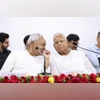 "Nitish Kumar with Lalu Yadav")
Lalu Prasad Yadav and Nitish Kumar at a public event — their decades-long journey from allies to rivals has shaped Bihar’s political landscape.(Photo: X/@laluprasadrjd)
Listen to This Article
Lalu Prasad Yadav and Nitish Kumar -- the two towering figures of Bihar's politics -- have had a tumultuous relationship, bordering on political differences and personal ambitions. Spanning over three decades, their association reflects the shifting sands of regional politics, caste loyalties, and coalition arithmetic.
From their early camaraderie to today's fierce competition, here is a comprehensive overview of their complex relationship.
From JP movement to political bond
Both Lalu and Nitish took their first political steps in 1975 when they joined the students’ movement launched by Jayaprakash Narayan, popularly known as the JP Movement. In their early years, they were very much part of the Mandal-era socialist cohort shaping Bihar’s political discourse by supporting the Mandal Commission's recommendations for OBC reservations in India.
In 1989, when Lalu became Leader of the Opposition in Bihar Assembly, Nitish not only supported him against more established figures but also served as his principal advisor. He even wrote his press notes.
1990s: Growing rift
In the late 1980s and early 1990s, as Lalu’s political graph rose in Bihar, Nitish focussed more on national politics. However, their alliance began to fracture amid ideological differences and governance disputes.
Also Read

 "Nitish Kumar, Nitish")
 "Roasted and spiced Foxnuts (Phool Makhana) (Photo: Wikimedia Commons)")
 "New Delhi Election, Election, Vote, Voting")
 "Pratima Kushwaha joins BJP")
 "Bihar Election")
By 1993–94, Nitish had parted ways from Lalu Yadav, forming the Samata Party and contesting independently in the 1995 Assembly elections – a move that signalled a clear break from Lalu’s leadership.
Lalu’s conviction in the Fodder Scam in further distanced the duo, as Nitish continued consolidating his governance narrative.
ALSO READ | Two decades of Nitish Kumar: How 'Sushasan babu' reshaped Bihar's story
1995–2005: NDA entry and the first chief ministerial stint
Nitish Kumar joined hands with the Bharatiya Janata Party (BJP) in Bihar for the first time during the 1996 Lok Sabha elections. The partnership continued in the 2000 Bihar Assembly polls, when he briefly became chief minister in March that year. However, he resigned within a week as he failed to prove his majority in the Assembly.
In 2005, Nitish became Bihar’s chief minister for the second time after his Janata Dal (United) party won 88 of the 139 seats it contested, while ally BJP secured 55 of 102 seats. Together, they crossed the majority mark of 122 in the 243-member Assembly, which had fewer seats at the time due to the creation of Jharkhand. This brought an end to 15 years of Lalu Prasad Yadav and Rabri Devi’s rule.
2015: The Mahagathbandhan
After poor electoral performance in 2014, Nitish recalibrated and reunited with Lalu's RJD and Congress to form the ‘Mahagathbandhan’ ahead of the 2015 Assembly elections. The alliance roared to power, securing 178 of 243 seats. Though RJD emerged as the largest party, Lalu ceded the chief ministership to Nitish.
2016–2017: The silence and split
Within a year, tensions surfaced as Nitish grew restless about Lalu’s influence via family members in cabinet roles. The 2017 CBI raids on Lalu’s family offered Nitish the pretext for quitting the alliance and returning to the NDA.
ALSO READ | Waqf Act promise: Can Tejashwi deliver if Mahagathbandhan wins Bihar polls?
2022–2024: Short-lived reunion
In August 2022, Nitish broke with BJP again to reclaim the Mahagathbandhan alliance.
By January 2024, Kumar had become dissatisfied with his role and perceived lack of influence within the broader opposition Indian National Developmental Inclusive Alliance (INDIA). Citing internal issues and dissatisfaction, he resigned as chief minister and promptly rejoined the BJP-led NDA, forming a new government in the state.
Early 2025: Lalu’s peace offering, Nitish’s rejection
In January, Lalu publicly extended an olive branch, stating Nitish was “always welcome” to rejoin the INDIA bloc. Nitish responded with a non-committal gesture, suggesting the prior alliances were mistakes and that he preferred the NDA alliance going forward.
Nitish's comment that aligning with Lalu had been a “mistake” underscores not only his drift from earlier camaraderie but also the sharp positioning ahead of November's Bihar polls.
ALSO READ | Ahead of Bihar polls, ECI warns parties against using AI-generated content
Brief timeline
1970s–1989 - JP Movement origins; Nitish advises Lalu as LoP (1989)
1993–1995 - Nitish splits, forms Samata Party; contests alone (1995)
2000 - Nitish briefly becomes CM with NDA support
2005 - Nitish returns as CM with BJP backing
2015 - RJD–JD(U) alliance wins, Lalu steps aside for Nitish
2017 - Nitish quits Mahagathbandhan amid corruption probes
2022 - Nitish rejoins RJD-led bloc
2024 - Nitish returns to NDA before polls
Jan 2025 - Lalu offers teams-up; Nitish calls past alliance a “mistake”
The relationship between Lalu Prasad Yadav and Nitish Kumar defies static characterisation. In 2025, the narrative is less about their shared history and more about divergent ambitions amid the high stakes of Bihar’s electoral landscape.
More From This Section
 "Tejashwi Yadav, Tejashwi")
 "ECI, election commission of india, election commission")
 "Tejashwi Yadav, Tejashwi")
 "Nitish Kumar, Nitish")
 "Congress BJP flags")
Topics : Nitish Kumar Lalu Prasad Yadav Bihar Election 2025 News Bihar Elections 2025 Bihar Assembly Elections Bihar Assembly
Don't miss the most important news and views of the day. Get them on our Telegram channel
First Published: Oct 27 2025 | 11:47 AM IST