


US clarifies who can stay during H-1B green card application process
Official says H-1B workers offering economic benefit or serving national interest may stay during green card process
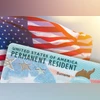 "US green card, US Passport, US immigration")
Photo: Shutterstock
Listen to This Article
Foreign professionals in the United States may not have to leave the country while applying for green cards if they provide economic benefit or serve the national interest, a government spokesperson has said.
The clarification came amid confusion over the US Citizenship and Immigration Services (USCIS) announcing that temporary visa holders seeking permanent residency would generally need to return to their home country and complete the process through consular processing.
The issue triggered anxiety among Indian H-1B workers, many of whom are already stuck in decades-long employment-based green card backlogs.
Speaking to Newsweek and Semafor, USCIS spokesperson Zach Kahler said applicants who provide an economic benefit to the US or otherwise serve the national interest would “likely be able to continue on their current path”, while others could still be asked to apply abroad depending on individual circumstances.
What changed in the US green card policy?
The clarification follows a USCIS policy memorandum issued earlier last week, which changes how the agency views “adjustment of status” applications filed inside the United States.
Also Read

 "heat waves, heat wave, summer, hot, heat")
 "q4 results today")
 "Class 12 CBSE board")
 "Food and grocery delivery workers and heatwave")
 "social media")
Adjustment of status, filed through Form I-485, has long allowed eligible temporary visa holders to apply for permanent residency without leaving the country.
Under the new interpretation, however, USCIS said adjustment of status would now be treated as an “extraordinary discretionary relief” instead of a routine immigration benefit.
The original announcement appeared to signal a much stricter approach.
“We’re returning to the original intent of the law,” USCIS had said earlier, adding that temporary visa holders wanting a green card would generally need to return to their home country unless there were “extraordinary circumstances”.
That statement sparked concern across the technology sector and among immigration lawyers, especially because Indian nationals make up the largest share of H-1B visa holders in the US.
Why H-1B workers are still in a stronger position
The latest clarification indicates that H-1B visa holders remain relatively protected because the visa category allows “dual intent”.
This means H-1B workers can legally hold temporary non-immigrant status while also pursuing permanent residency.
According to the USCIS memo, applying for adjustment of status is not inconsistent with maintaining H-1B status. However, USCIS also clarified that merely holding an H-1B visa does not automatically guarantee approval.
Immigration officers will now exercise broader discretion while deciding whether applicants can continue the process from inside the US.
Applicants who can demonstrate that their work benefits the US economy or serves the national interest are expected to receive more favourable consideration.
The clarification also suggests that workers on other dual-intent visas, including L-1 intracompany transfer visas, may continue to have stronger protections compared to holders of single-intent visas.
Indian professionals remain vulnerable
The development is particularly significant for Indian professionals working in technology, health care, engineering and finance sectors.
Indians account for the overwhelming majority of H-1B approvals in recent years and also face some of the longest waits for employment-based green cards, especially under the EB-2 and EB-3 categories.
For many Indian workers, leaving the US during the green card process could create serious disruptions involving jobs, family life and children’s education.
Immigration experts have also warned that mandatory overseas processing could expose workers to long visa appointment delays at US consulates abroad, increasing the risk of prolonged separation from employers and families.
The concerns are more acute for workers facing layoffs because H-1B holders typically get a limited grace period to secure a new employer or leave the country.
Concerns over legal and business impact
The proposed shift has already drawn criticism from parts of the US technology industry.
According to reports, LinkedIn co-founder Reid Hoffman described the move as “harmful” for technology companies and the broader US economy.
Immigration lawyer Todd Pomerleau also questioned whether the policy could survive court scrutiny, telling ABC News that administrative action alone cannot override immigration statutes passed by Congress.
The Trump administration, however, has defended the move, saying the changes are aimed at restoring the “original intent” of immigration law and preventing misuse of adjustment-of-status provisions.
What Indian H-1B workers should do
Immigration lawyers are advising Indian professionals to remain cautious despite the clarification.
Experts recommend that applicants:
- Maintain valid H-1B status wherever possible even after filing Form I-485
- Preserve documentation showing economic contributions or specialised skills
- Monitor future USCIS guidance closely, as the agency is expected to issue more detailed operational rules in the coming weeks
- Consult immigration attorneys before responding to any USCIS notices or requests
For now, the clarification has eased immediate fears of a blanket rule forcing all H-1B workers to leave the United States during the green card process. But the increased discretionary scrutiny means uncertainty is far from over for Indian professionals waiting for permanent residency.
More From This Section
 "Donald Trump,Trump")
 "India passport, Indian passport")
 "Green card")
 "Japan flag, Japan")
 "japan skyline, city")
Topics : BS Web Reports
Don't miss the most important news and views of the day. Get them on our Telegram channel
First Published: May 28 2026 | 11:26 AM IST