


Delhi chokes as AQI hits severe levels, fog worsens pollution across region
Delhi-NCR's air quality plunged into the severe zone on Monday, with fog trapping pollutants, 20 stations crossing 400, and authorities invoking Grap
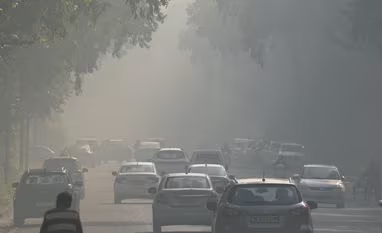 "Smog, Delhi Pollution, Delhi Air Quality, Pollution")
Anand Vihar was among the worst-affected locations. (Photo: PTI)
Listen to This Article
Air quality in Delhi-NCR turned 'severe' on Monday morning with several monitoring stations crossing the 400 mark, according to Central Pollution Control Board (CPCB) data. A shallow layer of fog settled over the region as temperatures dipped, reducing visibility and trapping pollutants close to the surface.
Out of 39 monitoring stations across the city, 20 recorded severe pollution. Anand Vihar was among the worst-affected locations, with a dense layer of toxic smog and an AQI of 440. Other major locations reported similarly hazardous levels: Jahangirpuri (455), Rohini (458), Ashok Vihar (436), ITO (409), Dwarka (401) and Burari (433).
Neighbouring regions also saw air quality deteriorate sharply. Noida recorded an AQI of 396 (very poor, nearing severe), Greater Noida logged 399 (very poor), and Ghaziabad touched 432 (severe).
By 4 pm on Saturday, Delhi’s 24-hour average AQI stood at 391 (very poor), a level considered harmful even for healthy individuals. Nineteen monitoring stations in Delhi recorded ‘severe’ air quality, while the remaining 19 logged ‘very poor’ levels above 300.
As per CPCB norms, AQI is categorised as: 0–50 ‘good’, 51–100 ‘satisfactory’, 101–200 ‘moderate’, 201–300 ‘poor’, 301–400 ‘very poor’ and 401–500 ‘severe’.
Also Read

 "delhi pollution protests, india gate protests")
 "air pollution")
 "Smog, Delhi Pollution, Delhi Air Quality, Pollution")
 "Smog, Delhi Pollution, Delhi Air Quality, Pollution")
 "work from home (WFH)")
Government measures to curb pollution
Revised Grap norms: The Commission for Air Quality Management (CAQM) has revised the Graded Response Action Plan (Grap) for NCR, shifting measures across stages for quicker action. Stage IV severe measures have been moved to Stage III, allowing states to decide whether public, municipal and private offices must operate at 50 per cent capacity.
50 per cent on-site staff: The Delhi government has ordered private offices to operate with only 50 per cent on-site employees, with the rest required to work from home. Staggered timings for government and MCD offices are already in effect until February 2025.
Supreme Court directives: The Supreme Court described Delhi’s pollution levels as “very serious” and urged lawyers to attend hearings virtually. A separate Bench led by Chief Justice B R Gavai and Justice K Vinod Chandran is monitoring pollution levels in Delhi and neighbouring states. The Court has also sought a status report from Punjab and Haryana on steps taken to prevent stubble burning, including enforcement and preventive action.
Schools shift to hybrid mode: Following GRAP Stage III, the Delhi Directorate of Education (DoE) has instructed government, aided and private schools to shift younger students to hybrid classes to limit exposure.
Weather forecast
Winter appears to have settled in the national capital. According to the India Meteorological Department (IMD), minimum temperatures will remain normal between –1.5 degrees Celsius and 1.5 degrees Celsius, for the next two days before dipping below normal to a range of –1.6 degrees Celsius to –3 degrees Celsius.
For Monday, the IMD forecast a mainly clear sky with shallow fog at most places and moderate fog at isolated pockets during morning hours. The maximum temperature is expected to hover around 26 degrees Celsius and the minimum around 11 degrees Celsius.
More From This Section
 "Modi, Narendra Modi")
 "Justice Surya Kant")
 "Bhagwant Mann, Bhagwant, Punjab CM")
 "Modi G20")
 "TDP BJP alliance 2025, Andhra Pradesh electoral rolls, SIR electoral revision, ECI citizenship controversy, Chandrababu Naidu Muslim outreach, NDA government stability, Andhra Pradesh voter list issue, BJP strategy in Andhra, Amaravati budget allocat")
Topics : Air Quality Index Delhi air quality Air quality Delhi Pollution Delhi weather BS Web Reports
Don't miss the most important news and views of the day. Get them on our Telegram channel
First Published: Nov 24 2025 | 9:39 AM IST