


Page 29 - European Union
Canada in talks with EU as it looks to reduce US defence reliance
Canada is in discussions with the European Union to join an EU drive to break its security dependency on the United States, with a focus on buying more defense equipment, including fighter jets, in Europe, a senior Canadian government official confirmed Wednesday. The official, who spoke on condition of anonymity as they were not authorized to speak publicly on the matter, said the plan includes building fighter jets in Canada. In Canada, where U.S. President Donald Trump has launched a trade war and has threatened economic coercion to make it the 51st American state, Defense Minister Bill Blair has been tasked by Prime Minister Mark Carney to review the purchase of America's F-35 fighter jets to see if there are other options given the changing environment, a defense spokesman said on the weekend. Carney has said the potential for having more production in Canada is a factor. A proposal by Sweden's Saab promised that assembly and maintenance of the Saab Gripen fighter jet would tak


Counterterrorism experts from EU, India exchange best practices at workshop
Counterterrorism experts and senior representatives from the European Union and Indian security agencies and policy institutions on Wednesday gathered here to exchange best practices on prevention, de-radicalisation and rehabilitation of violent extremists. The EU convened a technical workshop on preventing and countering violent extremism on the sidelines of the Raisina Dialogue, according to an official statement. Opened by EU Ambassador to India Herv Delphin, the workshop was organised in cooperation with the Embassy of the Netherlands. "The event brought together counterterrorism experts and senior representatives from EU and Indian security agencies and policy institutions, to exchange best practices on prevention, de-radicalisation, and rehabilitation of violent extremists," said the statement issued by the Delegation of the European Union to India. The EU delegation included security practitioners from European Union institutions, EU Member States including Belgium, Bulgaria
Google charged with breaching EU rules, Apple told to open up to rivals
The move by the European Commission came amid tensions with US President Donald Trump who has threatened to levy tariffs against countries which impose fines on US companies

EU proposes cutting steel imports by 15% from April as Trump tariffs bite
European steel producers already battling high energy prices and competition from Asia and elsewhere warn that the EU risks becoming a dumping ground for cheap steel diverted from the US

India, EU discuss bilateral ties, parliamentary exchanges, global issues
During EU President Ursula von der Leyen's visit to India in February, both parties directed their teams to conclude Free Trade Agreement (FTA) negotiations by the end of the year
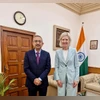
UK, EU to ramp up pressure on Russia and boost defence initiatives
The talks will coordinate cooperation on Ukraine and discuss efforts to increase economic pressure on Russia, UK's Foreign, Commonwealth and Development Office said in a statement

Trump's tariff priorities are Canada, Mexico, China, EU: Dhruva Jaishankar
According to him, India will be particularly hard hit along with other nations

This will be breakthrough year for India and EU: Ex-Swedish PM Carl Bildt
Bildt stated that both sides are committed to reaching an agreement by the end of the year

Syria to join donor conference for 1st time, a key step for its new leaders
The European Union hosts a donor conference for Syria on Monday to muster support to ensure a peaceful transition after President Bashar Assad was ousted by an insurgency last December. Ministers and representatives from Western partners, as well as Syria's regional neighbors, other Arab countries and UN agencies will take part in the one-day meeting in Brussels which will be chaired by EU foreign policy chief Kaja Kallas. Syria will attend the conference the ninth edition of its kind for the first time, and will be represented by Foreign Minister Asaad Hassan al-Shibani. The event was organized in haste by the EU to try to take advantage of the change sweeping the country. The gathering comes at a precarious time. Syria's new leaders are trying to consolidate control over territory that was divided into de facto mini-states during nearly 14 years of civil war and to rebuild the country's economy and infrastructure. The United Nations in 2017 estimated it would cost at least $250

US-EU tariff war risks $9.5 trn of business: American Chamber of Commerce
Trump has railed against the US goods trade deficit with the EU, although in services there is a US surplus, and urged manufacturers to produce in America

India should seek reciprocity in free trade agreement talks with EU: GTRI
"While the EU demands zero tariffs on medical devices from India, it maintains high regulatory barriers that make Indian exports difficult in EU markets," GTRI founder Ajay Srivastava said

Indian defence sector stocks lock and load, ready for export offensive
Investor firepower reloaded, targeting domestic growth, exports, and European rearmament

Thousands gather in Serbia's capital for rally that tests Vucic's govt
Tens of thousands of people swarmed the streets in Serbia's capital Belgrade on Friday, staging a joyful prelude to a major anti-government rally on the weekend and dealing a blow to populist President Aleksandar Vucic. The citizens of Belgrade came out to welcome thousands of university students who converged on Belgrade from across the country for the rally planned for Saturday that is expected to draw even more people. Saturday's protest is seen as a culmination of months of anti-graft demonstrations in the Balkan country that have posed the biggest challenge so far for Vucic's decade-long firm grip on power in Serbia. Flares, fireworks and flag-waving crowds filled the downtown streets in stark contrast to weeks of fear-mongering spread by Vucic's populists with an aim to dissuade people from attending the rally on Saturday. The autocratic leader has repeatedly warned that violence is planned at the rally and threatened arrests over any incidents. Vucic's supporters have been .

EU carbon border policy may hurt global climate cooperation: Study
Implementation of unilateral Carbon Border Adjustment Mechanism-like policies across jurisdictions can increase costs for exporters, complicate trade relations and potentially weaken collaborative global climate efforts, a study has found. According to the study -- conducted by researchers from the Indian Institute of Management (IIM)-Lucknow and the Institute of Management Technology (IMT)-Ghaziabad -- the EU's Carbon Border Adjustment Mechanism (CBAM) can pose challenges for India's small- and medium-sized steel enterprises due to financial, technological and capacity constraints. In the first-of-its-kind study, the researchers tested if the EU's ability to extend its regulation beyond borders, commonly known as the "Brussels Effect", would drive decarbonisation in India's steel industry through the CBAM. The researchers found that while large integrated steel plants might adapt their production to supply lower-carbon steel for the EU market, smaller and medium-sized enterprises .
Trump escalates trade war, pledges more tariffs after EU, Canada's response
The latest decision has marked an escalation in the already heated trade war between the US and other nations

UK breaks from EU stance, opts against swift tariff retaliation on US
Business and Trade Secretary Jonathan Reynolds called the US decision to impose 25 per cent levies on foreign metal products without exemptions on Wednesday morning "disappointing"

Countermeasures to Trump's tariffs will go into effect on April 1, says EU
The European Union on Wednesday announced retaliatory trade action after the Trump administration officially increased tariffs on all steel and aluminum imports to 25%, with duties on industrial and agricultural products that will go into effect April 1. As the US are applying tariffs worth 28 billion dollars, we are responding with countermeasures worth 26 billion euros (USD 28 billion), European Commission President Ursula von der Leyen said in a statement. The commission manages trade and commercial conflicts on behalf of the 27 member countries. We will always remain open to negotiation. We firmly believe that in a world fraught with geopolitical and economic uncertainties, it is not in our common interest to burden our economies with tariffs, von der Leyen said. The commission also said that steel and aluminum products would be hit in return, but also textiles, leather goods, home appliances, house tools plastics and wood. Agricultural products will also be impacted including
Amid US-Ukraine tensions, Starlink's European rival sees shares soar 500%
Eutelsat has the infrastructure to expand its role in Ukraine, whose troops rely on Starlink for internet connectivity to operate drones, secure messaging, and real-time coordination

EU hits back at Trump tariffs with measures on $28 billion of US goods
US-EU trade dispute: The Trump administration recently imposed 25% tariff on European steel and aluminium imports

EU chief asks member nations to use European, not American defence systems
European Union countries must purchase military equipment made in Europe under a new loan programme meant to help the continent provide for its own security, a top EU official said Tuesday, even though most of its defence materiel currently comes from US suppliers. At a summit last week, the EU's 27 leaders weighed a European Commission proposal for a new loan plan worth 150 billion euros (USD 163 billion). It would be used to buy air defence systems, drones and strategic enablers like air transport, as well as to boost cybersecurity. These loans should finance purchases from European producers, to help boost our own defence industry, Commission President Ursula von der Leyen told EU lawmakers. Von der Leyen said the contracts should be multiannual, to give the industry the predictability they need and that the priority should be for countries to buy equipment together in groups because we have seen how powerful this can be. European NATO members have placed about two-thirds of th