


How a $27 document at Harvard turned out to be a priceless Magna Carta
A $27.50 document bought in 1946 and stored at Harvard Law School has been identified as a rare 1300 Magna Carta, making it the seventh known surviving copy of the historic charter
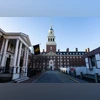 "Harvard University")
The document was confirmed as an authentic 1300 Magna Carta issued by King Edward I of England. (Image: Bloomberg)
Listen to This Article
A forgotten document purchased for just $27.50 nearly 80 years ago has been identified as a rare and original 1300 edition of the Magna Carta. Long overlooked in the Harvard Law School Library's archives, this find adds a seventh known copy to the six already recognised worldwide.
The document was confirmed as an authentic 1300 Magna Carta issued by King Edward I of England. Its discovery began in December 2023 when Professor David Carpenter, a medieval history expert at King’s College London, stumbled upon a digitised image of the document in Harvard's archives.
“My reaction was one of amazement and, in a way, awe that I should have managed to find a previously unknown Magna Carta,” Carpenter told the news agency Associated Press.
First issued by King John in 1215, the Magna Carta is considered one of the foundational texts in the history of law and civil rights. It introduced the principle that no individual, not even a monarch, is above the law — a concept that has influenced legal systems across the world, including that of the United States.
"There are only four known originals from 1215," Carpenter said. "So to come across another rare version from 1300 is something quite incredible."
Also Read

 "Harvard University")
 "Harvard University President Alan Garber")
 "Harvard University")
 "Harvard University")
Scholars use imaging to authenticate the manuscript
To validate the find, Carpenter teamed up with Professor Nicholas Vincent of the University of East Anglia. The duo began by comparing the Harvard copy to the six other known 1300 editions. The document’s dimensions, text, and handwriting all matched the known characteristics of originals from that year.
Using ultraviolet light and spectral imaging, Harvard librarians had previously created detailed scans that revealed features invisible to the naked eye. These high-tech tools allowed the scholars to scrutinise details such as the large capital ‘E’ in ‘Edwardus’ and other stylistic elements typical of the 1300 copies.
The 1300 version is historically significant because it was the last full edition of the Magna Carta to be officially reissued and sealed by the English monarchy.
Beyond its legal and historical significance, the document's journey to Harvard is equally fascinating. Vincent traced its origin to Appleby, a former parliamentary borough in Westmorland, England.
The library acquired it in 1946 from a London book dealer, who misdated it to 1327. Vincent uncovered that it had previously belonged to Forster Maynard, a World War I flying ace who also served in the defence of Malta during World War II. Maynard had inherited the document from abolitionist campaigners Thomas and John Clarkson. It’s believed that William Lowther, lord of the manor of Appleby and a friend of Thomas Clarkson, may have gifted it to him.
“There’s a chain of connection there, as it were, a smoking gun, but there isn’t any clear proof as yet that this is the Appleby Magna Carta,” Vincent noted. “But it seems to me very likely that it is.”
A symbol of legal freedom amid modern-day challenges
Vincent and Carpenter are planning a visit to Harvard in June to view the document in person. They believe the Magna Carta’s message is particularly resonant today, as Harvard faces increasing scrutiny from government authorities over its governance, admissions policies, and campus activism.
“It turns up at Harvard at precisely the moment where Harvard is under attack as a private institution by a state authority that seems to want to tell Harvard what to do,” Vincent said.
The discovery offers an opportunity to reintroduce the Magna Carta’s principles to new generations. Its influence can be seen in the United States Constitution, the Declaration of Independence, and the Bill of Rights. Today, 17 US states incorporate Magna Carta principles into their legal frameworks.
(With agency inputs)
More From This Section
 "FBI, Federal Bureau of Investigation")
 "Christine Lagarde, WEF")
 "JD Vance, Vance")
 "Donald Trump, Trump")
 "Crime, Prison, Law, Arrest, Punishment")
Don't miss the most important news and views of the day. Get them on our Telegram channel
First Published: May 16 2025 | 9:26 AM IST