


Israel-Iran conflict: Who are the Kurds and why are they in focus again
Spread across Turkey, Iran, Iraq and Syria, the Kurds are the world's largest stateless ethnic group. Their long struggle for autonomy now intersects with rising geopolitical tensions
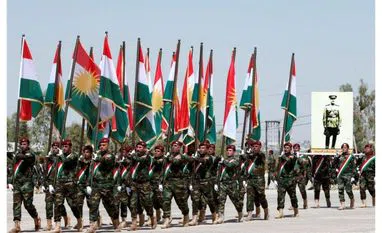 "Kurd, Kurdish group")
Across several countries in West Asia, Kurdish communities have long faced political repression. and armed conflict. Image: Wikimedia Commons
Listen to This Article
Reports that the US Central Intelligence Agency (CIA) is engaging Kurdish armed groups in Iran and Iraq have once again put the Kurds, an often-marginalised people spread across several West Asian countries-back in the global spotlight. Here’s who the Kurds are and a look at their history.
Who are the Kurds?
The Kurds are an ethnic group indigenous to the Mesopotamian plains and surrounding mountain regions. Their traditional homeland stretches across parts of Turkey, Syria, Iraq, Iran, and Armenia.
Together, these areas are often referred to as Kurdistan. However, Kurdistan is a cultural and geographic region rather than a recognised country, meaning Kurds are spread across multiple states and do not have a nation of their own.
Today, an estimated 30-40 million Kurds live around the world, making them widely regarded as the largest stateless ethnic group globally. Large Kurdish diaspora communities also live across Europe, particularly in Germany, France, the Netherlands, and Switzerland.
Kurds share a distinct culture, traditions and language. Kurdish belongs to the northwestern branch of the Iranian languages within the Indo-European family and includes several regional dialects.
Also Read

 "US green card, US Passport, US immigration")
 "Petronet LNG (Photo: LNG Prime)")
 "Iran, US Iran, Israel Iran, LNG, Strait of Hormuz")
 "L&T, larsen and toubro, larsen and toubro")
 "US Israel strike Iran")
Most Kurds are Sunni Muslims, although Kurdish communities also include followers of Shia Islam, Alevism, Yazidism, and Christianity, reflecting the region’s religious diversity, according to a report by Al Jazeera.
Why have Kurds faced repression?
Across several countries in West Asia, Kurdish communities have long faced political repression, armed conflict and restrictions on cultural and political rights.
Turkey
In Turkey, where Kurds make up about 15-19 per cent of the population, Kurdish language and identity were heavily restricted for decades.
The conflict intensified after the Kurdistan Workers' Party (PKK), founded in 1978 by Abdullah Ocalan, launched an insurgency in 1984 seeking an independent Kurdish state. The decades-long conflict between Turkish forces and the PKK has killed more than 40,000 people and displaced many others. In recent years, the PKK has shifted its demands from independence to greater cultural and political rights.
Iran
In Iran, Kurds account for nearly 10 per cent of the population. Tensions rose after the Iranian Revolution of 1979, as Kurdish groups demanded greater autonomy and cultural recognition from the Shia-dominated government in Tehran.
Kurdish uprisings during the 1980s and 1990s were suppressed, forcing many fighters and civilians to relocate to northern Iraq.
One militant group, the Kurdistan Free Life Party (PJAK), was formed in 2004 and has continued armed attacks on Iran’s Islamic Revolutionary Guard Corps (IRGC). Kurdish armed groups have increasingly positioned themselves as key actors in the opposition to the Iranian regime, combining on-ground mobilisation with political messaging aimed at building international support.
Iraq
In Iraq, Kurds make up about 15 per cent of the population and have repeatedly fought for autonomy.
Repression reached its peak in 1988 when the regime of Saddam Hussein carried out a chemical attack on the Kurdish town of Halabja, killing around 5,000 people. After the Gulf War, Kurds established the semi-autonomous Kurdistan Regional Government in northern Iraq.
However, their push for full independence suffered a setback after a 2017 independence referendum, which was rejected by Baghdad and led Iraqi forces to retake several disputed territories.
Syria
Kurds make up around 10 per cent of the population in Syria and have faced decades of marginalisation. A 1962 census in Hasakah stripped roughly 120,000 Kurds of citizenship, leaving many families stateless for generations.
During the Syrian civil war, Kurdish groups took control of some northern areas after government forces withdrew in 2012. Kurdish militias, particularly the People's Protection Units (YPG), later played a key role in fighting the Islamic State of Iraq and the Levant (ISIL).
Major Kurdish political organisations
Several Kurdish political and militant organisations operate in and around Iran.
The oldest among them is the Democratic Party of Iranian Kurdistan (KDPI), founded in 1945, which maintains a contingent of Peshmerga fighters.
Other groups include:
- Kurdistan Free Life Party (PJAK)
- Kurdistan Freedom Party (PAK)
- Komala Party of Iranian Kurdistan
- Khabat Organisation
On February 22, as talks between the US, Israel and Iran were underway, five of these groups, formed a new alliance called the 'Coalition of Political Forces of Iranian Kurdistan'.
Why the Kurds are back in focus now
Amid escalating hostilities with Iran, officials in the administration of Donald Trump and the CIA are weighing the possibility of arming Iranian Kurdish opposition groups to increase pressure on Tehran, according to CNN.
Discussions are said to include potential military assistance and the possibility of Kurdish fighters launching attacks on Iranian security forces from bases in northern Iraq.
However, Karoline Leavitt, the White House press secretary, said Trump had spoken with Kurdish leaders regarding US military bases in northern Iraq but had not approved any plan to arm Kurdish fighters.
Meanwhile, Iran’s Revolutionary Guards said they had destroyed positions belonging to Iranian Kurdish groups in Iraq, accusing them of planning infiltration operations against Iran.
As the West Asia conflict widens, the Kurds, long caught between competing regional powers, are once again at the centre of geopolitical tensions.
More From This Section
 "Iran warship")
 "us iran, us flag, iran flag")
 "Nepal, Kathmandu")
 "Iran, Iran flag")
 "Mahatma Gandhi in Montana")
Don't miss the most important news and views of the day. Get them on our Telegram channel
First Published: Mar 05 2026 | 1:31 PM IST