


Iran loses key commanders as Israeli strikes hit major military sites
Israeli airstrikes killed top Iranian military leaders, including the IRGC chief, in a major escalation that struck Tehran and other cities, damaging Iran's defence and nuclear assets
 "Iran attach, Israel attack on iran, strike")
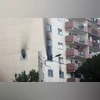
A building stands damaged in the aftermath of Israeli strikes in Tehran. | Image: Reuters
Listen to This Article
Israeli airstrikes on Friday inflicted a severe blow on Iran’s military leadership, with Iranian state media and officials confirming that at least three top generals were killed. Among them was Major General Mohammad Bagheri, the chief of staff of Iran’s armed forces, making him the most senior figure reported dead. One of his deputies was also said to have died in the strikes.
Iranian media reported the deaths of three other prominent figures: General Gholamali Rashid, a senior officer in the armed forces; Mohammad Mehdi Tehranji, an Iranian physicist; Fereydoun Abbasi, a nuclear scientist.
While Israel has a history of targeting Iranian nuclear scientists and security figures through covert operations, Friday’s events marked a sharp escalation. Unlike previous operations focused on individuals in Lebanon or Syria, this round of attacks struck directly inside Iran—including the capital, Tehran—and simultaneously eliminated several high-ranking officials. Strikes targeted military leaders’ homes, even within secure compounds, leading to the collapse of entire apartment blocks in some parts of Tehran.
IRGC commander killed in Tehran blast
The Islamic Revolutionary Guards Corps (IRGC) confirmed that General Hossein Salami, the commander of the elite force, was killed in one of the strikes in Tehran. He died along with several other IRGC personnel, according to a statement issued by the organisation.
Also Read

 "US President Donald Trump")
 "Jay Shree Tea, Darjeeling tea, Darjeeling tea gardens, tea estates, Tea Exports")
 "Iran, Iran flag")
 "Mirwaiz Umar Farooq, Mirwaiz Umar")
 "Stock broker, broker, trader, marker, markets, stock markets, stock, market crash, market fall, loss")
Iran’s Supreme Leader, Ayatollah Ali Khamenei, who also serves as the country’s commander-in-chief, issued a stern warning on state television. “Israel should anticipate a harsh punishment. The strong hand of the Islamic Republic will not let them go,” he declared.
He added that several senior military officials and nuclear scientists had been killed in attacks on residential areas. “The Zionist regime with this crime has created a dark and painful fate for itself, and it will definitely receive it,” he said. Notably, he did not mention the United States in his statement.
Most severe foreign attack since Iran-Iraq War
Iran has not faced such widespread and forceful attacks by a foreign adversary since the Iran–Iraq War in the late 1980s. Ayatollah Khamenei had long sought to avoid open conflict, even during tense moments with Israel last year. However, on Thursday night, Iranian authorities signalled a shift, openly acknowledging that the country was now preparing for war. The effectiveness of that response, however, may be limited due to the damage inflicted on Iran’s command structure and air defence systems.
According to a report by The New York Times, quoting four Iranian officials, Israeli missiles struck at least a dozen key locations, including military bases and nuclear and missile facilities across Tehran, Tabriz, Isfahan, Kermanshah, and Arak. The nuclear site at Natanz sustained significant damage, and a major highway connecting Tehran to Isfahan was also affected.
ALSO READ: Israel-Iran LIVE updates
Top nuclear negotiator also killed
Ali Shamkhani, a former naval commander and a key political figure close to Ayatollah Khamenei, also died after being severely injured in an attack on his luxury penthouse in northern Tehran. Shamkhani had been leading nuclear negotiations with the United States through a committee appointed by Khamenei. His death, officials said, was an attempt to derail nuclear diplomacy.
As head of the Revolutionary Guards, General Salami was responsible for protecting Iran’s borders and defending the country from external threats. Following his death, the Guards’ spokesperson vowed to “respond decisively and harshly to the aggression of the Zionist enemy” and promised a strong response against both Israel and the United States.
Why Israel hit Iran?
Israel has said the strikes were carried out to stop Iran from advancing towards the development of nuclear weapons, as the country nears the threshold for weapons-grade uranium enrichment. Prime Minister Benjamin Netanyahu said that the operation targeted the Natanz nuclear facility, key figures in Iran’s nuclear programme, and its stockpile of ballistic missiles.
Israeli authorities claim that Iran’s leadership has long called for the destruction of Israel — not just as a political position, but as a central goal. Iran, however, insists that its nuclear programme is for peaceful purposes. Following the Israeli strikes, Iranian MP Aladdin Boroujerdi said the sixth round of nuclear talks with the US has been canceled. The discussion was scheduled to take place in Oman on June 15.
More From This Section
 "Donald Trump, Trump, Elon Musk")
 "Elon musk, musk, Elon")

 "Iran-Israel war")
 "Donald Trump, Trump")
Topics : Israel Iran Conflict Iran Tehran Nuclear reactors
Don't miss the most important news and views of the day. Get them on our Telegram channel
First Published: Jun 13 2025 | 4:02 PM IST