


Trump's tariff hike sparks global concerns over prices and trade turmoil
Trump ramped up his trade war with tariff rates from 10 per cent to nearly 50 per cent. He says the levies will bring jobs back to the United States
 "Donald Trump")
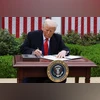
Trump sees tariffs as a way of protecting the US economy from unfair global competition and a bargaining chip for better terms of trade. | Photo: Reuters
Listen to This Article
Businesses around the globe on Thursday faced up to a future of higher prices, trade turmoil and reduced access to the world's largest market after US President Donald Trump confirmed their worst fears by instituting broad tariffs worldwide.
Trump ramped up his trade war with tariff rates from 10 per cent to nearly 50 per cent. He says the levies will bring jobs back to the United States, but company executives were focused on possible increases to prices, reducing shipments or cutting back investment activity outright.
"These tariffs will push prices higher on thousands of everyday goods - from phones to food - and that will fuel inflation at a time when it is already uncomfortably persistent," said Nigel Green, CEO of global financial advisory deVere Group.
Also Read

 "auto parts, automobile parts, car parts")
 "Donald Trump")
 "Donald Trump")
 "trade")
 "shoe footwear campus shoes sandals sports")
Contrasting with Trump's long-term plan for job creation, carmaker Stellantis on Thursday said it would temporarily lay off 900 US employees.
The workers are based at facilities in Michigan and Indiana which support assembly plants in Mexico and Canada, where production has been paused following the imposition of tariffs.
"We understand that the current environment creates uncertainty," said Antonio Filosa, Stellantis' chief operating officer of the Americas in an email to staff shared with Reuters. He said the company was engaged with "top government leaders, unions, suppliers and dealers in the US, Canada and Mexico" as it adapts to the changes.
Shipping companies, one of the main conduits of global trade, were among the first to sound the alarm while many other business leaders kept a low profile as they pondered the new reality.
"It clearly isn't good news for (the) global economy, stability and trade," Maersk, the world's second-largest container shipping firm, said in a statement.
German container shipping firm Hapag-Lloyd also said that tariffs could affect demand, cargo flows and costs.
The world's fifth-biggest container liner said it could be forced to adjust its service network in response.
Those fears were echoed by Dirk Jandura, president of Germany's BGA association, representing importers and exporters.
"We will have to translate the tariffs into price increases, and in many cases that means a drop in sales," he said.
Asian producers hit
Trump sees tariffs as a way of protecting the US economy from unfair global competition and a bargaining chip for better terms of trade.
The most common method of dealing with tariffs is to raise prices, passing along the cost to customers as far as possible.
Other companies may try to diversify supply chains, but Trump's additional 34 per cent tariff on China was accompanied by 46 per cent and 49 per cent tariffs on Vietnam and Cambodia, respectively - all Asian countries to which companies had been shifting output.
Shares in Western sportswear brands Nike, Adidas and Puma all dropped sharply on Thursday as Vietnam, Indonesia, and China are leading markets for them to source products.
In the United States, retailers Target and Best Buy have said they will have to raise prices, but their margins are more likely to be squeezed.
Shares in Apple fell 8 per cent, reflecting concerns over the iPhone maker's big manufacturing base in China.
US drinkers will meanwhile pay more for cocktails, champagne and foreign beers, drinks industry bodies said.
Some European companies that primarily serve higher-income consumers were planning to raise prices even before confirmation of the 20 per cent tariffs on European Union imports.
Italy's Illy Caffe and Ferrari have both said they will lift prices, calculating premium coffee drinkers and sports car buyers will be able to absorb the extra cost.
Lavazza, another Italian coffee company, said it could accelerate plans to expand its plant in the US. Giovanna Ceolini, head of Confindustria Accessori Moda, which represents Italian companies in the footwear, leather, fur and tannery industry, said the US tariffs had come when companies are already struggling with increased costs.
"We are afraid that for our companies there will be a slowdown (in demand). It will depend on whether Americans are willing to pay a little more (for our goods)," she said.
Jefferies analysts anticipate a 6 per cent increase in US luxury prices as companies seek to protect margins.
Investment call
The White House says tariffs will encourage more onshoring, similar to the revamped USMCA trade deal Trump signed during his first term that encouraged manufacturing activity to shift from China to Mexico or Canada.
The most severe risk, according to executives interviewed by Reuters, is that businesses simply stop investing.
Spice Kitchen, a small business based in Liverpool, England which sells spices and gift boxes, said its plans to expand in the US were now under threat.
"It's a scary time, because as a business we see the US as a really big opportunity for export," co-founder Sanjay Aggarwal told Reuters. "This sort of tariff puts a lot of that into question."
(Only the headline and picture of this report may have been reworked by the Business Standard staff; the rest of the content is auto-generated from a syndicated feed.)
More From This Section
 "global economy")
 "Donald Trump, US President Trump")
 "White House")
 "US President Donald Trump")
 "French President Emmanuel Macron, France, Macron")
Don't miss the most important news and views of the day. Get them on our Telegram channel
First Published: Apr 03 2025 | 11:07 PM IST