


Strikes rock West Asia for third day; energy, airspace face major impact
As the conflict entered its third day, energy infrastructure, digital systems and maritime routes came under strain, while diplomatic channels struggled to keep pace with military escalation
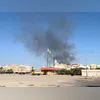 "US Israel strike Iran")
Smoke rises from an area surrounding U.S. Embassy following a strike in Bayan, Kuwait, March 2, 2026, in this screengrab from a video. (Photo: Reuters)
Listen to This Article
Military action across West Asia entered a third day on Monday, with energy facilities, digital infrastructure and regional airspace coming under direct impact as the United States and Israel intensified operations against Iran and its allies.
3rd day of strikes across the region
The United States and Israel continued coordinated strikes on Iran and allied groups, while Tehran expanded retaliatory attacks across the Persian Gulf and beyond. Israeli fighter jets flew over Tehran. Iran launched explosive drones across Gulf waters. Hezbollah fired rockets from Lebanon into Israel, prompting Israeli airstrikes on positions outside Beirut.
US warplanes struck Iranian targets for a third consecutive day. The widening theatre of conflict drew in additional regional actors and raised the risk of a broader regional war.
3 US jets shot down in Kuwait
Three American fighter jets were shot down over Kuwait during what US Central Command described as “an apparent friendly fire incident”.
“During active combat — that included attacks from Iranian aircraft, ballistic missiles and drones — the US Air Force fighter jets were mistakenly shot down by Kuwaiti air defences,” Central Command said in a statement. All six crew members “ejected safely, have been safely recovered and are in stable condition”, it added, thanking Kuwait for its role in the campaign against Iran.
Also Read

 "textile, textiles")
 "Car sales")
 "Crude oil")
 "tea, garden")
 "India's largest listed hotel company, Indian Hotels Company,")
The incident occurred as Iran targeted American assets across the Persian Gulf in retaliation for the US-Israeli operation that killed Supreme Leader Ayatollah Ali Khamenei on Saturday. Several US bases and facilities in the region came under attack, prompting Gulf states to activate air defence systems.
Saudi Aramco facility targeted
Saudi Aramco temporarily shut its Ras Tanura refinery after Iranian drones struck the facility. Ras Tanura is one of the kingdom’s principal refining hubs, and the attack raised concerns about wider disruption to regional energy infrastructure.
Aramco had not issued an official statement at the time of writing. However, Saudi Arabia’s defence ministry spokesperson told Al Arabiya television that two drones targeting Ras Tanura were intercepted.
UAE data centre hit; AWS services disrupted
Amazon Web Services reported power and connectivity issues at its cloud facilities in the United Arab Emirates after unidentified “objects” struck a data centre.
According to AWS’s status page, the objects triggered a fire on Sunday, forcing authorities to cut power to two data-centre clusters. Restoration was expected to take several more hours.
Localised power disruptions affected AWS services in both the UAE and neighbouring Bahrain. A person with direct knowledge of the matter said financial institutions relying on AWS services were impacted.
The incident occurred on the same day Iran launched drones and missiles at Gulf states in response to US and Israeli strikes. If confirmed as a military strike, it would mark the first instance of a major US technology company’s data centre being taken offline by armed conflict.
Pentagon briefing: No timeline given
At a Pentagon news conference lasting around 40 minutes, US Defence Secretary Pete Hegseth declined to provide a timeline for the conflict.
President Donald Trump had suggested that operations could continue for four to five weeks. Hegseth said such timelines “could move up or move back”, adding that the president would determine the war’s length and look for “opportunities, off ramps” as well as moments to escalate. “He has all the latitude, and I am glad he does,” Hegseth said.
General Dan Caine stated that when additional fighter jets arrive in the coming days, the US would be “just about where we want to be in terms of total combat capacity and total combat power”, but he did not disclose overall force numbers.
When asked whether American troops were on the ground in Iran, Hegseth, as quoted by The New York Times, said: “No, but we’re not going to go into the exercise of what we will or will not do. Why in the world would we tell you, you, the enemy, anybody, what we will or will not do in pursuit of an objective?”
General Caine said, “I wish that every American could hear the voice communications, like I have, as these joint operation centres remain calm, focused and cool while under fire over and over again.” He, as per The New York Times, further said, “Collectively, these systems have intercepted hundreds of ballistic missiles targeting us, our forces, our partners and regional stability.”
He said US air defences had “proven effective”, though some Iranian attacks struck American bases, Israel and Arab states.
Meanwhile, the US embassy in Iraq ordered all mission personnel to shelter in place and advised American citizens to avoid travel to Iraq, warning that demonstrations could turn violent with little warning.
Global air travel disrupted as Gulf hubs shut
Global air travel disruption intensified as the conflict triggered widespread flight suspensions across major Gulf transit centres. Governments began coordinating efforts to assist stranded citizens after the fighting erupted on Saturday and severely affected international travel schedules.
Airports in Dubai, Abu Dhabi and Doha — key transit hubs linking Europe, Africa and the West with Asia — remained closed after being directly struck during Iranian retaliatory attacks.
Emirates, which operates out of Dubai International Airport, one of the world’s busiest aviation hubs, said it would resume a “limited number of flights” on Monday evening but did not provide operational details. The airline had earlier announced suspension of services until 3 pm local time on Tuesday.
The United Arab Emirates’ General Civil Aviation Authority said authorities were covering all “hosting and accommodation costs” for passengers affected by cancellations and diversions. According to a statement carried by state news agency WAM, approximately 20,200 passengers had been processed as of Sunday following flight rescheduling.
QatarEnergy halts production of LNG
QatarEnergy suspended liquefied natural gas production after military attacks on its facilities in Ras Laffan and Mesaieed. The company confirmed the halt in a statement.
Qatar is one of the world’s leading LNG exporters, alongside the United States and Australia. The move added to concerns over global energy supply stability.
EU calls for diplomacy
European Union commissioners met to discuss the situation. European Commission President Ursula von der Leyen said in Brussels, “The stability of the region is of the utmost importance: The only lasting solution is a diplomatic one.”
Putin speaks with leaders of UAE
Russian President Vladimir Putin spoke with the leaders of the United Arab Emirates and Qatar. According to the Kremlin, UAE President Sheikh Mohammed bin Zayed told Putin that retaliatory strikes hit his country despite it not being used as a base for attacks on Iran. Putin said he would convey the message to Tehran.
Oil tanker hit in Gulf of Oman; Indian mariner killed
A bomb-carrying drone boat struck a Marshall Islands-flagged oil tanker in the Gulf of Oman off Muscat, killing one crew member. Oman’s state news agency identified the vessel as MKD VYOM and said the deceased mariner was from India.
Iran has issued threats against vessels approaching the Strait of Hormuz and is believed to have launched multiple maritime attacks since the US-Israeli air campaign began.
The incident placed India directly within the human cost of the conflict.
PM Modi speaks to Saudi and Bahrain leaders
Prime Minister Narendra Modi spoke with Saudi Crown Prince and Prime Minister Mohammed bin Salman and Bahrain’s King Hamad bin Isa Al Khalifa on Monday, condemning the recent attacks on both countries.
“Discussed the evolving situation in West Asia with Crown Prince and PM of Saudi Arabia, HRH Prince Mohammed bin Salman. India condemns the recent attacks on Saudi Arabia in violation of its sovereignty and territorial integrity,” Modi said on X.
“We agreed that the earliest restoration of regional peace and stability is of utmost importance. I thanked him for looking after the well-being of the Indian community in these difficult times,” he added.
In a separate post, Modi said: “Had a productive telephone conversation with the King of Bahrain, His Majesty King Hamad bin Isa Al Khalifa. India condemns the attacks on Bahrain and stands in solidarity with its people in this difficult hour. I thank him for the steadfast support extended to the Indian community in Bahrain.”
Iran rejects reports of negotiation with US
Ali Larijani, a senior Iranian security official, criticised Trump’s war aims as “delusional fantasies” and denied reports that Iran’s new leadership sought negotiations with Washington.
Concern rose across Asian economies over potential disruption to oil flows from the Middle East, a key supplier to India, China, Japan, South Korea and others. While several countries hold strategic reserves, a prolonged conflict or a blockade of the Strait of Hormuz would pose serious economic risks.
More From This Section
 "Emmanuel Macron, Emmanuel, Macron")
 "Modi, Narendra Modi")
 "US Secretary of Defense Pete Hegseth")
 "Volodymyr Zelenskyy, Zelenskyy")
 "Strait of Hormuz")
Don't miss the most important news and views of the day. Get them on our Telegram channel
First Published: Mar 02 2026 | 9:15 PM IST