


Mann Ki Baat: PM allays fears of farmers on Land Bill
Says Oppn spreading canards to keep farmers poor, insists pro-owner provisions in earlier law not touched or being improved, flaws weeded
)
<b>picture courtesy @PMOIndia</b>


Prime Minister Narendra Modi on Sunday described the controversial amendments proposed by his government to the land acquisition law as a "misinformation" ploy to keep rural India poor.
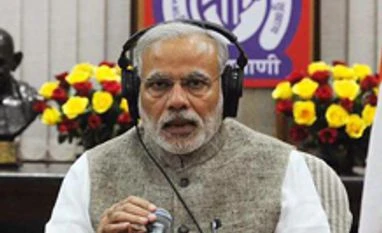
Addressing farmers on the Mann ki baat (Speaking your mind) programme on All India Radio, the PM in a lengthy address said the Bill was prepared with the welfare of farmers, their families and of villages in mind.
The address comes after the Centre managed to clear the amendments in the Lok Sabha on the back of its majority but faces a big challenge in the Rajya Sabha, where it does not have the numbers, due to a united opposition.

Itemised reply
Modi said all the pro-farmer provisions of the 2013 Act had been retained fully in his Bill. In a clause by clause rebuttal of the various claims, Modi said it was the Congress-led governments in Maharashtra and Haryana which had decided to lower the amount of compensation to be paid as mandated by the 2013 law.
"I won't commit the sin of lowering the compensation,” he said. Modi also said the then Congress-led government had passed the 2013 legislation in haste, that this had many flaws and his government had tried to rectify the shortcomings. He said they’d brought 13 legislations under the new Bill’s purview, all exempted in the previous law.
Farmers were to get compensation at the old rates if their lands were acquired under the earlier provisions but the new Bill provides full compensation in this regard.
As noted earlier, the law in question was enacted in 2013; it is formally termed The Right to Fair Compensation and Transparency in Land Acquisition, Rehabilitation and Resettlement Act. After the Modi-led government came to power in 2014, the Act was amended through an ordinance, on the grounds that state chief ministers had demanded some changes after they found that acquiring had become cumbersome. Apart from opposition parties, the ordinance has was criticised by a host of civil society activists.
Modi said the provision for compensation at four times the market value had not been touched. Farmers would get a fifth of their land if developed in case of acquisition for urbanisation. There is provisions for employment to the family whose land has been acquired and to family members of labourers dependent on the land, he said.
"We have also added a provision through the ordinance that a government official in the district who gives the employment will have to declare in writing on the nature of employment, where it has been provided, number of people who have been provided employment, so that responsibility can be fixed," Modi said.
First of all, available government land would be used, followed by barren land. Fertile land would be acquired only if unavoidable. "Authorities have been asked to conduct surveys of barren lands immediately," he said.
Also…
On the abolition of a Social Impact Assessment (SIA) if acquiring for five sectors, which include rural infrastructure and affordable housing, the PM said SIA would have led farmers to a long litigation and acquisition process. "I can't let farmers fall into the trap of officialdom," he said, adding that he’d tried to make this simpler. He said abolition of the consent clause for rural infrastructure projects would also ensure the fruits of development reached everyone and weren’t restricted to those who owned land near highways or canals.
And, he added, if any state was unwilling to abide by the new law, it was free to do so.
Dismissing allegations that the Bill would primarily benefit corporate groups and the private sector, he asked if acquisition for highways, railways, housing for the poor and irrigation projects were meant for corporates.
The PM asserted consent of farmers would be mandatory for acquiring land for the purpose of private industry and corporate groups. However, in the case of a private-public partnership, the consent clause will not apply as the ownership remains with the government. The job of the private party is only to develop the land for a public purpose. However, in this case, too the land owner is to get full compensation.
"The ordinance does not take away the right of farmers to appeal; it has been guaranteed to us by the Constitution of India," Modi said. Acquisition had been restricted in the intended law, he said, to a km on both sides of industrial corridors. People living in nearby areas would get jobs and not need to migrate to big cities and live a miserable life.
On a clause in the ordinance diluting the five-year return provision of the earlier Act, Modi said it was a myth. The reality was that the ordinance had a provision for fixing the time-frame of a project; if not developed in that period, a decision on the land would be of the original owners.
"Through this provision, we have tried to fix the responsibility on governments to deliver projects on time," he said.
Other matters
Expressing concern on recent crop damage due to unseasonal rain and hail, the PM said his government was fully with farmers and all central departments were in touch with the states concerned. Ministers were taking stock.
On issues raised by farmers in letters to him, Modi assured them he’d fully activate the government machinery, take corrective measures and hasten the process where required.
He said the government had come up with the idea of a soil health card for farmers, so they could save on indiscriminate use of fertiliser. He said they were working on ensuring remunerative prices for produce, setting up mandis and seeing that farmers were not exploited.
On his tenure as Gujarat chief minister, Modi said he’d worked hard on irrigation and the condition of farmers had substantially improved. He said farmers made an immense contribution to the development of Gujarat and he wanted to see such a change across the country. Asking farmers to continue writing to him, he said he’d again address them.
Don't miss the most important news and views of the day. Get them on our Telegram channel
First Published: Mar 23 2015 | 12:42 AM IST