


Dollar falls to lowest level since February
The dollar weakened 1.7 per cent to $1.3524 per euro
)
The dollar fell to its lowest level since February as markets were whipsawed by Federal Reserve communications on keeping monthly bond purchases unabated depending on the strength of the US economy.
The US currency fell against the majority of its 16 most- traded peers for a third-straight week as the US central bank announced September 18 it kept $85 billion in monthly bond purchases unchanged, compared with a Bloomberg survey forecasting a $5 billion reduction. The dollar rose on Friday after Fed Bank of St Louis President James Bullard said a "small tapering" was possible in October. The euro's rally was the most since July as the currency's economy emerges from a record-long recession and German Chancellor Angela Merkel stands for re-election tomorrow.
The Bloomberg US Dollar Index, which tracks the performance of a basket of 10 leading global currencies against the dollar, fell 1 percent this week to 1,013.28 in New York. It reached 1,006.40 on September 19, the lowest level on a closing basis since February 20.
Market prices
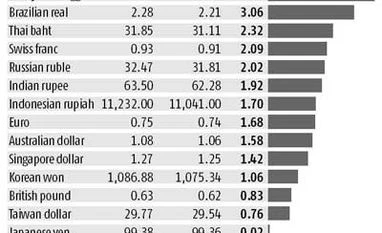
The dollar weakened 1.7 per cent to $1.3524 per euro. The dollar was little changed at 99.36 yen. Japan's currency lost 1.7 per cent to 134.37 versus Europe's 17-nation common tender, touching the weakest level since November 2009.
Hedge funds and other large speculators increased bets the euro will gain against the dollar to almost the highest level since July 2011, according to data from the Commodity Futures Trading Commission. The difference in the number of wagers by on a gain in the currency compared with those on a loss -- known as net longs -- was 31,907 on September 10, compared with 12,696 a week earlier.
Currency volatility as measured by JPMorgan Chase & Co's G-7 Volatility Index rose to 8.94 per cent after touching 8.55 per cent on September 18, the lowest since January. An equally weighted basket of so-called BRICS emerging-market currencies rallied for a third week. BRICS refers to Brazil, Russia, India, China and South Africa.
While India's central bank Governor Raghuram Rajan surprised analysts by raising the benchmark interest rate to 7.5 per cent in his first policy review, the nation's currency fell yesterday, as traders reassessed Fed policy that has driven investors into higher yielding assets.
The rupee added 1.9 per cent this week to 62.2775 per dollar. It's down about 12 per cent this year.
Emerging markets
"The knee-jerk buying of emerging-markets stocks has, for now, run out of steam," said Win Thin, the global head of emerging-markets strategy at Brown Brothers Harriman & Co in New York. There's "continued uncertainty about the exact timing, but, tapering still looms."
Fed Chairman Ben S Bernanke has orchestrated the most aggressive monetary stimulus in the central bank's 100-year history, pumping up the balance sheet to $3.72 trillion from $867 billion in August 2007 and holding the main interest-rate target at almost to zero since December 2008.
The Fed repeated guidance that its rate target will remain low for at least as long as unemployment exceeds 6.5 per cent, and the outlook for inflation remains no higher than 2.5 per cent. Markets worldwide also rallied this week after former Treasury Secretary Lawrence Summers withdrew from the running to succeed Bernanke, paving the way for Fed Vice Chairwoman Janet Yellen, who is forecast to favor slower stimulus reduction.
Fed policy
The central bank will likely begin tapering in December as part of a process that will completely wind down quantative easing by the middle of next year, Joseph Lavorgna, chief US economist in New York at Deutsche Bank Securities Inc, wrote yesterday in a note. The central bank will likely increase its federal funds rate target in mid-2015, he said.
"The economy can handle higher interest rates," Lavorgna said. "One, yields remain extraordinarily low; two, households are anticipating higher rates, and, three, a steeper yield curve is encouraging bank lending." Most economists surveyed by Bloomberg now say the policy makers will begin tapering asset purchases in December.
"Since we kind of had to reset our thoughts on how this was going to happen, any comment now by any Fed person will be highly scrutinized," Fabian Eliasson, head of US currency sales in New York at Mizuho Financial Group Inc, said in a phone interview.
Merkel runs
In Europe, polls suggest the election is Merkel's to lose, with Germans trusting her leadership, backing her austerity- first response to Europe's debt crisis and crediting her for economic gains.
An index of household confidence in the Euro zone improved to minus 14.9, the highest level since July 2011, from minus 15.6 a month earlier, the European Commission in Brussels said yesterday in a preliminary report. Economists had forecast an increase to minus 14.5, according to the median of 23 estimates in a Bloomberg News survey.
European Central Bank President Mario Draghi will address the European Parliament on September 23. He has refrained from printing euros to buy bonds.
The euro has appreciated 5.4 per cent this year, the best performer of 10 developed-nation currencies tracked by Bloomberg Correlation-Weighted Indexes. The dollar appreciated 2.5 per cent and the yen slumped 11.9 per cent.

Don't miss the most important news and views of the day. Get them on our Telegram channel
First Published: Sep 21 2013 | 9:46 PM IST