


Why mentor Advani is upset with protege Modi?
Clearly unhappy over Modi's 'elevation', Advani is willing to back anyone but the Hindutva poster boy
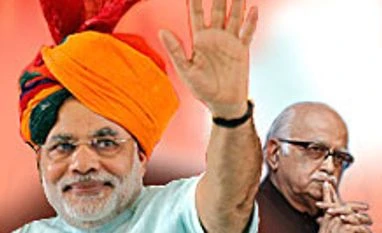)
If Gujarat Chief Minister Narendra Modi does get elevated, will it mean the beginning of the end of the Lal Krishna Advani’s illustrious career as Bharatiya Janata Party's (BJP) frontline leader? Many say it is too early to write him off. Will he project himself as an alternative to the non-Congress and non-Narendra Modi faction in case of a hung Parliament in 2014?
Political observers are of the view that he has not given up his dreams of becoming the National Democratic Alliance’s (NDA) prime ministerial candidate and would like to keep this option open till the last minute.
Political observers are of the view that he has not given up his dreams of becoming the National Democratic Alliance’s (NDA) prime ministerial candidate and would like to keep this option open till the last minute.
Advani was the strategic mastermind of the BJP and it was he who managed its electoral fortunes. As a leader, he had both the astuteness and the generosity to realise that when the BJP came to power earlier, Atal Bihari Vajpayee would be a more uniting force than he himself was. He stood aside. Now, decades later he realises that Modi is not a Vajpayee and stands concerned. He faces a party whose cadres are tom-toming for the Hindutva poster boy and he thinks things are much more complex at present.

Drum-beating does not necessarily ensure electoral success. During the Emergency, then Congress president Dev Kant Barooah had said, ‘India is Indira, Indira is India’. Indira Gandhi was routed in the elections that followed. At present, Team Rajnath Singh might think that Modi supplies the right dose of adrenalin. Advani and Co feels Modi’s projection could see either a stagnation in seats or even a fall, especially if the Muslims rallied behind the Congress party.
The Advani-Sushma duo gave strong signals that Modi’s leadership would at best make a difference of 20 to 30 seats for the BJP, which was anyway riding high on an anti-incumbency factor against the United Progressive Alliance (UPA). However, the potential losses from his prospective projection could outshine the gains.
I
The BJP is strong in at least three of the four states (Madhya Pradesh, Chhattisgarh and Rajasthan) going to polls and the Advani camp is confident that Madhya Pradesh CM Shivraj Singh Chouhan will come back with a thumping majority, bolstering his stature at the national level and thus give Advani a handle against Modi.
The BJP’s patriarch tried to project Chouhan as a counterweight to Modi. In the party's realignments, while BJP chief Rajnath and Arun Jaitley are seen as favourably disposed to Modi, Sushma Swaraj and Ananth Kumar are believed to be close to Advani. But many party cadres are displeased with the senior leader’s bid to stall Modi.
It is believed that Advani is also promoting leaders like Sushma, who is more acceptable to him as the prime ministerial candidate, if he does not get nominated himself. Modi has alienated the top leaders of the party including Advani because of his alleged arrogance and reluctance to take others along with him. At this stage, it is not to BJP’s advantage to project a disunited front ahead of the Assembly or the Lok Sabha polls. This would send a wrong signal to the electorate.
There is no personality clash with Modi but Advani is fighting for the survival of the party. In coalition era, the anchor of an alliance can be a national party. But, the regional parties hold the balance of power in determining who rules New Delhi. The two essential ingredients for the working of a smooth coalition are that the national parties must display large-heartedness for accommodating regional players. Regional parties similarly must evolve a national outlook.
Since 1999, when it won 182 seats, the BJP’s total numbers in the Lok Sabha have successively dipped to 138 in 2004 and 116 in 2009. The party’s national vote share has also fallen from 23.75 to 18.8% over this period.
The need to project someone more acceptable in order to expand its coalition base — which is what enabled the party to win seats even in states like Karnataka, Tamil Nadu, Odhisa and Andhra Pradesh — is also something that the patriarch has learnt from years of electoral battleground experience.
The Lok Sabha has 543 elected seats and the magic figure to stake claim to form government is 272. Arun Jaitley and many other senior BJP leaders want the 2014 campaign to be like the US presidential election — a personality-based clash — in which Modi dominates his rival.
Don't miss the most important news and views of the day. Get them on our Telegram channel
First Published: Sep 13 2013 | 12:24 PM IST