


StatsGuru: Tracking the monsoon
 "Click on graphic")
<I>Click on graphic</I>
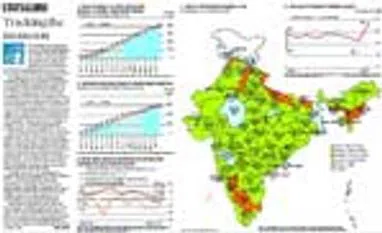
On Thursday, the southwest monsoon began withdrawing from parts of western Rajasthan. Latest data show that as of September 17, rains have been five per cent below normal. This is marginally better than the six per cent deficit on September 13 as shown in Chart 1.
By comparison, the India Meteorological Department (IMD) had predicted rains to be at 106 per cent of the long period average (LPA). Currently the LPA for the whole country is 89 cm. Rainfall below 90 per cent of the LPA is considered as deficit, while that between 96 to 104 per cent of LPA is considered as normal. Till last Wednesday, the country had received 76.6 cm of rainfall. But there is wide variation across regions. As shown in Chart 2, the deficit in the southern peninsula is to the tune of 11 per cent. The river basin-wise distribution of rainfall is shown in Chart 3. Cauvery river basin has received 23 per cent less rainfall than normal.
While the withdrawal of the rains has been delayed by 15 days, based on current trends, experts contend that it is unlikely that rainfall will be in line with IMD's forecast. IMD's track record of accurately predicting the monsoon has not been up to the mark, especially over the past two years, as shown in Chart 4. In both the previous years, actual rainfall was well below IMD's predictions, raising questions about the accuracy of its forecasting models.
But after two back-to-back droughts, a good monsoon has provided the much-needed boost to kharif sowing with area under cultivation increasing by 3.6 per cent. For pulses, which along with vegetables have been largely responsible for the sharp rise in food inflation, the area under cultivation has increased by 28.9 per cent over last year.
An increase in production will help ease food supplies, putting downward pressure on prices. This could bring down food inflation, which, as seen in Chart 5, has ratcheted up this year. If food inflation eases going forward, it could create room for the Reserve Bank of India to lower rates. Ishan Bakshi

Don't miss the most important news and views of the day. Get them on our Telegram channel
First Published: Sep 19 2016 | 12:24 AM IST