


Sandeep Das's book argues for going beyond strategy to implementation
A good strategy always calls for friction - it is never a straight line
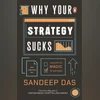 "Why Your Strategy Sucks by Sandeep Das")
Why Your Strategy Sucks by Sandeep Das | File Image
Listen to This Article
Why Your Strategy Sucks
by Sandeep Das
Published by
Penguin
256 pages ₹399
Also Read

 "Book Cover")
 "TO LOSE A WAR: The Fall and Rise of the Taliban")
 "No, Minister")
 "Superbloom: How Technologies of Connection Tear Us Apart")
 "Former New Zealand Prime Minister Jacinda Ardern's")
In his highly quoted article “What is Strategy” published almost two decades ago (Harvard Business Review, November-December, 1996), Professor Michael Porter had laid out the contours of what should be called “strategy”. He clarified that strategy is not a place-holder for what could be called operational excellence. Strategy called for clear choices to be made. It starts with choosing a unique position that is grounded in clear activities that are difficult for competition to imitate. Strategy also calls for trade-offs, dropping some things and focusing on a few things. And good strategy always calls for friction and is never a simple, clean line.
Given this grounding, it was with great expectation that I picked up Why Your Strategy Sucks by Sandeep Das. The author is an MBA with over 15 years of experience in both the corporate world and consultancies. His previous book was a look at business storytelling.
Why Your Strategy Sucks is presented in five parts. Part 1 is the introduction to strategy. Part 2 is about strategy for corporations. Part 3 is about strategy for you. Part 4 is on necessary skill building. Part 5 is on careers in strategy. Written in a light-hearted tone and peppered with humour, the author has tried his best to make this rather heavy topic easy to approach and appreciate.
The most important chapter in the book is probably the one titled “Thinking Strategically About Strategy”, where the author presents his Strategic Thinking Framework. This framework also appears in many other chapters. It consists of six steps: Define Problem (1. Understand scope, 2. Identify objective); Create Strategy (3. Identify framework, 4. Generate options, 5. Prioritise options); Deploy Strategy (6. Develop implementation charter).
A good strategy is as good as the implementation or execution. The most often quoted book on the topic of execution is the book, duh, Execution by Lawrence Bossidy and Ram Charan. Their book emphasises that successful businesses are built on effective execution of strategy, not just on brilliant ideas. The book argues that leaders must actively engage in the implementation process, fostering a culture of accountability and linking strategy to operations and people.
In Why Your Strategy Sucks, the author has spent time stressing the importance of implementation. The book presents what is called the “implementation charter framework” that has three parts: Implementation charter objective; Stakeholders — who should do it; Incentive — why should they do it; Capability — what will they do; and continuous tracking through a dashboard.
Through the book the author has demonstrated the Strategic Thinking and Implementation Charter framework to illustrate several examples from the world of strategy and the world of recruitment and HR.
The book gives the reader a quick tour of the strategic thinking process adopted in companies. Most books on strategy stop with that. This book is different to the extent that it takes the strategic thinking process and applies it to an individual’s career planning. There is a chapter on what skills you need to develop if you want to get into a strategy role.
Each chapter is full of examples and anecdotes. For the sake of confidentiality, many of the names have been masked. It would have been good if some of the real-life strategy cases had been presented.
For the sake of quick revision, each chapter ends with a summary that we can go to, if in doubt. Full of quotes, some real, some fictitious, the book is a well-packaged presentation. Here is a sampler: “The future is shaped by your dreams, so stop wasting time and go to sleep”— the author’s favourite quote, by the way.
In the field of management and strategy consultants who have either lost all their hair or at least lost all their black hair, each claiming to have served clients across continents for several decades, Sandeep Das comes across as a breath of fresh air. He is definitely a lot younger, writes with a light touch and doesn’t take himself too seriously. That has not held him back from writing an engaging book that is useful for a seasoned professional and to a newcomer.
The reviewer is a bestselling author of 12 books. His latest is Marketing Mixology’ – Four Essential Ingredients for Marketing Success
More From This Section
 "The Party's Interests Come First: The Life of Xi Zhongxun, Father of Xi Jinping")
 "Meet the Savarnas: Indian Millennials Whose Mediocrity Broke Everything")
 "Book")
 "India, election, ECI")
 "The Art of War and Peace: The Changing Face of 21st-Century Warfare")
Don't miss the most important news and views of the day. Get them on our Telegram channel
First Published: Aug 20 2025 | 11:23 PM IST