


PM Narendra Modi hints at bringing fresh scheme for electoral funding
Modi said the next govt will share these drafts with the states, and invite their inputs, which he hopes to discuss threadbare with the CMs at a NITI Aayog meeting to be called after Lok Sabha polls
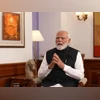 "PM Modi during pre-poll interview with ANIT on April 15, 2024 (Photo: ANI)")
PM Modi during pre-poll interview with ANIT on April 15, 2024 (Photo: ANI)
Prime Minister (PM) Narendra Modi has said that the Opposition received the lion’s share of the donations from companies that purchased the bonds after being investigated by probe agencies and is now spreading misinformation on the issue.
Modi said there could be shortcomings in a decision, but he intended to curb the use of unaccounted money in elections and indicated that the next government could bring a revised, improved scheme for electoral funding.
In an interview with the news agency ANI, webcast on the PM’s website on Monday evening, the PM also indicated that the states would drive the country’s development agenda in the future.
He spoke of the draft that he had prepared of the tasks to be accomplished in the first 100 days of the next government, the subsequent five years, and also in the next 25 years.
Modi said the next government will share these drafts with the states, and invite their inputs, which he hopes to discuss threadbare with the chief ministers at a NITI Aayog meeting to be called after the conclusion of the Lok Sabha elections.
Also Read

In his 77-minute interview, the PM spoke on a host of issues, including the electoral bonds scheme, the Enforcement Directorate’s action on the corrupt, how his “personal” touch disrupted the Ministry of External Affairs “protocol-minded diplomacy”, which helped in delivering the G20 Declaration, and also the Congress manifesto.
If implemented, the Opposition’s manifesto would “crush” the country’s economy and the future of its youth, especially those below 25 years of age, the PM said.
He said it was a matter of concern for the country that the party of Mahatma Gandhi and also of Indira Gandhi, who were devout Hindus, now had an alliance with those criticising Sanatana Dharma. The PM said central agencies were misused in the past, including when he was the Gujarat chief minister (CM) and the state’s home minister was put in jail. He said only 3 per cent of those investigated by the probe agencies were politicians.
“Is it the Opposition’s case that they were running their parties?” the PM asked, adding that he was committed to ending corruption.
The PM said he would prepare a 100-day agenda as the Gujarat CM and also did before the 2019 Lok Sabha polls as well, which is why his government could repeal Article 370 and take several other decisions within the first 100 days of its tenure. He said he has been working on the 2047 agenda for the past few years.
The PM said the basis of the draft will be the Bharatiya Janata Party (BJP) manifesto, and the 1.5 million suggestions from the people for Viksit Bharat, and he has also contacted universities and organisations. Modi said he has used artificial intelligence to classify their suggestions subject-wise and set up teams of officers to work on this in each department.
On Tesla chief Elon Musk’s India visit, the PM said the interest that the industrialist has shown is not because of their friendship but because Musk was an admirer of India and recounted their meeting in the US in 2015. Modi spoke of Foxconn, Google, Apple, and Samsung setting up facilities in India.
“My objective is that foreign investment should lead to technology transfer and give youths jobs. It shouldn’t be the case that we export wheat and end up importing bread,” the PM said.
On the electoral bonds issue, Modi accused the Opposition of spreading misinformation and that those criticising it will regret their approach on honest introspection. He said 3,000 companies donated to political parties through electoral bonds of which 26 had faced action from probe agencies. Of these, 16 companies purchased the bonds after they were investigated. Only 37 per cent of their total donation amount went to the BJP, while the remaining 63 per cent of the funds went to the Opposition parties, he said.
He said the electoral bonds scheme was a step towards reducing the influence of black money in elections, contrary to claims made by Opposition leaders and critics.
“The success story of electoral bonds is that we now have a trail of which company donated, how much, and to whom it donated. Whether what happened in the process was good or bad could be a point of debate,” the PM said.
The PM said there could be drawbacks to decision-making, but one learns after discussions.
“There is a lot of scope for improvement in this also. But today we have completely pushed the country towards black money,” he said, adding that people criticising the scheme will regret their approach to honest introspection.
The PM said demonetisation curtailed the use of unaccounted money in elections. “The (demonetised) currency notes were moved in large quantities during the elections. We took the step so that black money ends,” the PM said.
He said his government’s motivation in introducing electoral bonds was pure. “We were looking for a way. We found a small way, we never claimed that this was the absolute way,” the PM said.
To a question that there were concerns among a section of people about a National Democratic Alliance government with a 400-seat majority, the PM said he doesn’t take decisions to pressurise or scare people.
“My decisions are for the holistic development of the nation,” he said. The PM said voters, especially first-time voters, should consider the BJP’s track record of the last 10 years, where it has delivered on its promises, and that of five to six decades of the Congress’ failed model.
Of the 10 years, the PM said, his government lost two years because of the pandemic. He said his objective was to increase the speed and scale of development.
On allegations that the government had an undue influence on the functioning of the Election Commission of India, the PM spoke of how former election commissioners were those close to the Congress’ first family or later became Rajya Sabha members and even ministers in the Congress-led government. Without naming the Congress leadership, the PM said they were trying to find a scapegoat for their forthcoming electoral loss.
More From This Section
Topics : Narendra Modi Electoral Bond Lok Sabha elections India Prime Minister Niti Aayog Electoral funding
Don't miss the most important news and views of the day. Get them on our Telegram channel
First Published: Apr 15 2024 | 10:27 PM IST