


'Fancy toy for billionaires': Aiims doctor on Zomato CEO's 'Temple' device
After Zomato CEO Deepinder Goyal showcased a mysterious brain-sensing wearable, an Aiims Delhi doctor has publicly dismissed it as having "zero scientific standing"
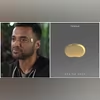 "Zomato CEO Deepinder Goyal, Temple device")
Zomato CEO Deepinder Goyal wearing the experimental ‘Temple’ device during a recent podcast appearance. (Photo: @deepigoyal | Instragram)


Listen to This Article
A small wearable spotted near Zomato CEO Deepinder Goyal’s eye has triggered a big debate. The device, called Temple, claims to measure blood flow in the brain continuously in real time and is part of an experimental effort to study ageing and longevity. But an Aiims Delhi doctor and scientist has now publicly dismissed the device as having “zero scientific standing”, warning people against trusting or spending money on unproven health gadgets.
The controversy erupted when Goyal showcased the device during a popular podcast appearance that quickly caught public attention.
What is the ‘Temple’ device and what does it claim to do?
Temple is an experimental wearable sensor developed under Continue Research, a health and longevity venture backed by Goyal and linked to Zomato’s parent company, Eternal. According to Goyal, the device aims to calculate cerebral blood flow accurately and continuously, something that, if proven, could be significant for neuroscience and ageing research.
Goyal has also floated a provocative idea alongside the device that gravity may play a direct role in human ageing. He has described Temple as open-source, science-backed, and part of a broader curiosity-driven quest to understand human longevity. Around $25 million of his personal wealth has reportedly gone into this research.
Temple is not available for public sale yet and is currently an experimental tool.
Also Read

 "Vinay Kwatra")
 "PMI, PMI INDIA")
 "Reliance")
 "Donald Trump, Trump")
 "Noida Pollution, Pollution, Smog")
Why has an Aiims doctor called it a ‘fancy toy’?
Responding publicly on X, Dr Suvrankar Datta, an AI researcher and radiologist from Aiims Delhi, described Temple as having “zero scientific standing” as a useful medical device at present.
Drawing on his background as a physician-scientist and an early researcher in arterial stiffness and pulse wave velocity, which are key markers linked to cardiovascular mortality, Dr Datta warned people against spending their hard-earned money on unvalidated wearables.
In his words, these are “fancy toys” that only the ultra-wealthy can afford to experiment with.
“As a physician-scientist and one of the earliest researchers in India in Arterial Stiffness and Pulse Wave Velocity (2017) which predicts cardiovascular mortality, I can assure you that this device currently has 0 scientific standing as a useful device and do not waste your hard earned money to buy fancy toys billionaires can afford to waste money on. If you are one, then go ahead,” Dr Datta wrote on X.
As a physician-scientist and one of the earliest researchers in India in Arterial Stiffness and Pulse Wave Velocity (2017) which predicts cardiovascular mortality, I can assure you that this device currently has 0 scientific standing as a useful device and do not waste your hard… https://t.co/pm0pxGRycd
— Dr. Datta M.D. (AIIMS Delhi) (@DrDatta_AIIMS) January 4, 2026
Does the ‘Temple’ device have any clinical validation yet?
As of now, there is no publicly available clinical evidence showing that Temple can reliably measure cerebral blood flow in humans in real-world settings, let alone predict ageing or lifespan.
In medicine, devices that claim to measure physiological parameters must undergo years of testing, first in controlled experiments, then in clinical trials, and finally through regulatory scrutiny. Without this process, experts caution that such wearables may offer curiosity, not clarity.
Is gravity-linked ageing backed by established science?
The idea that gravity influences ageing is not entirely outlandish, as research on astronauts has shown that microgravity affects bones, muscles and circulation. However, extending this to claim that gravity directly shortens human lifespan on Earth is, at best, a hypothesis.
At present, this theory sits firmly in the realm of speculative research, not established biomedical science. Experts stress that hypotheses need data, replication and consensus before they can inform health decisions.
For more health updates, follow #HealthWithBS
This content is for informational purposes only and is not a substitute for professional medical advice.
More From This Section
 "UK junk food ad ban")
 "diabetes")
 "mental health, men's health")
 "tattoo")
 "Diwali weight gain")
Don't miss the most important news and views of the day. Get them on our Telegram channel
First Published: Jan 06 2026 | 10:41 AM IST