


'Go corona, go': 5 years to Covid-19 lockdown and the frenzy that followed
Five years ago, on March 24, the first lockdown was announced by Prime Minister Narendra Modi to contain the spread of novel coronavirus. Here's recounting what happened after the lockdown commenced
 "migrant workers")
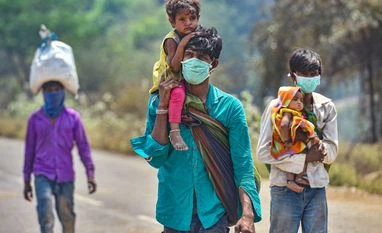
Daily wage migrant workers were stranded with no way home due to the sudden announcement of lockdown. (Photo: PTI)
Listen to This Article
On March 24, 2025, everything seems normal again. Crowds are back in markets, vehicles back on roads, cinephiles queuing outside movie theatres, and cricket stadiums registering overwhelming crowd for the new season of the Indian Premier League. But five years ago, on this very day, India came to a standstill.
At 8 pm on March 24, 2020, Prime Minister Narendra Modi appeared on television to make an important announcement: a 21-day nationwide lockdown to capture the growing cases of novel coronavirus. The lockdown would start from midnight the same night - with only a four-hour notice.
"The next 21 days are of critical importance for us. As per health experts, a period of at least 21 days is extremely critical to break infection chain of coronavirus. If situation is not handled in these 21 days, the country and your family could go back 21 years. If situation is not handled in these 21 days, several families will get devastated forever," the PM said in his address.
This came five days after he had urged the public to follow a self-imposed one-day 'janata curfew,' which meant not leaving homes or roaming onto the streets. The decision was made when the country had approximately 500 confirmed cases of Covid-19. By restricting movement and closing non-essential services, the government sought to prevent the healthcare system from becoming overwhelmed by a surge in Covid-19 cases.
But the sudden announcement triggered panic. People rushed to buy essentials, crowding markets and defeating the purpose of social distancing. Public transport stopped overnight, leaving millions—especially daily wage migrant workers—stranded with no way home.
Also Read

 "Vietnam")
 "WTO, World Trade Organisation")
 "Raja Raghuvanshi, Sonam")
 "tourist indian traveller")
 "RCB, IPL")
Migrant hardships
Announced on March 25, the lockdown went on till April 14, 2020. It restricted the movement of India’s 1.3 billion population, with essential services like hospitals and grocery shops operational, but public transport halted. The government allocated Rs 15,000 crore for health infrastructure, including personal protective equipment (PPE), testing laboratories, and quarantine centres.
One of the most visible impacts was the mass exodus of migrant workers, estimated at over 120 million, who formed the backbone of India’s urban economy. Many lost their jobs overnight as industries shut down, leaving them with no income and no savings. With buses, trains, and flights suspended, millions began walking hundreds or even thousands of kilometers to their villages, often carrying their belongings and families.
The government responded with a $22.6 billion relief package and 'Shramik Special' trains, ferrying over 3 million migrants, but many waited weeks. Tragic outcomes followed, including the death of at least a dozen migrants in road accidents.
Escalation of Covid cases
When the lockdown began, India had about 500 Covid-19 cases. But despite the restrictions, infections kept rising. By 14 April 2020, India had recorded over 10,000 cases and more than 350 deaths.
Initially, the lockdown slowed the spread. The time it took for cases to double increased from six days in early April to eight days by mid-April. But the virus proved relentless. The first major wave hit in September 2020, with over 90,000 new cases daily, showing that the pandemic was far from over.
Historic markets crash
While the health crisis worsened, India’s stock market also suffered one of its worst crashes in history.
On March 23, 2020, it fell by 13.15 per cent (3,934.72 points), and the Nifty plunged by 12.98 per cent (1,135 points), marking the largest single-day decline in Indian market history. Collectively, investors lost Rs 13.88 trillion in a single day.
Comparing from the beginning of the year, Sensex plunged 38 per cent from 41,952 in January 2020 to 25,981 on March 23, 2020. The Nifty followed a similar trend, dropping from 12,362 in January to 7,610 on March 23, 2020.
However, following the lockdown announcement, the markets showed resilience. On March 25, 2020, Sensex posted its biggest gains in 11 years, adding significant value for investors.
The impact was also felt on India INC. Major companies like Larsen & Toubro, Bharat Forge, and Tata Motors temporarily shut down operations. The manufacturing sector struggled, with industries like automobiles and electronics halting production. This severely affected jobs and supply chains, bringing economic activity to a near standstill.
What did India learn?
The Covid-19 lockdown was a harsh but valuable lesson for India. While the sudden shutdown was heavily debated, it bought time to scale up testing, medical infrastructure, and public health measures. However, it also exposed deep flaws—India’s healthcare system was unprepared, and millions of informal workers were left without support.
At the same time, the crisis forced India to embrace technology in ways never seen before. Contact tracing apps and real-time data dashboards became crucial tools for tracking Covid-19 cases and managing quarantines. This showed how digital technology could improve public health responses and help manage future crises more effectively.
Five years later, the scars of the lockdown remain, but so do the lessons. The world has moved on, but the memories of those days—of empty streets, long walks home, and the fight against an invisible enemy—will never be forgotten.
More From This Section
 "Allahabad High Court, Justice Yashwant Varma")
 "Bullet train, train, railway")
 "Delhi Assembly, Delhi Legislative Assembly")
 "Security forces,army,soilder")
 "Pasala Krishna Bharati")
Don't miss the most important news and views of the day. Get them on our Telegram channel
First Published: Mar 24 2025 | 9:19 AM IST