


PSA Mumbai Terminal eyes 50% share in JNPA's container traffic by 2027
PSA Mumbai Terminal to double capacity to 4.8 MTEUs by 2027, boosting exports and connectivity with DFC readiness
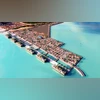 "PSA Mumbai Terminal")
PSA is a global port operator and a supply chain firm that originated from the Port of Singapore Authority. It runs the terminal under a revenue-share deal with JNPA.
Listen to This Article
PSA Mumbai Terminal (Bharat Mumbai Container Terminal) plans to raise its share of Jawaharlal Nehru Port Authority’s (JNPA’s) container traffic from 35 per cent in 2025 to 45–50 per cent by the end of 2027 through its phase-two expansion.
The fully green terminal, with phase-one capacity of 2.4 million twenty-foot equivalent units (MTEUs), will double to 4.8 MTEUs by 2027. “Right now, we use five out of six berths. Technically, phase 2 is fully up and running. We will add capacity every six months. We just go with the demand,” said Ashwin Arvind, deputy executive director, PSA Mumbai.
The terminal's Phase 1 delivered deep berths, cranes, and terminal systems. Phase 2 added 1,000 meters of quay (total 2,000), higher yard capacity, more cranes and RTGs, plus a dedicated freight corridor (DFC)-ready rail depot. The USD 1.3 billion investment covers both phases.
PSA is a global port operator and a supply chain firm that originated from the Port of Singapore Authority. It runs the terminal under a revenue-share deal with JNPA.
The second phase was inaugurated on Thursday by Prime Minister Narendra Modi virtually. “India is working at great speed to strengthen its port infrastructure, and Singapore’s expertise in this field is of immense value. This milestone will further enhance our container handling capacity,” Modi said.
Also Read

 "GST reform")
 "COURT, JUDGEMENT, HIGH COURT")
 "Suhora Technologies")
 "Dixon Technology")
 "IIFL Home Finance")
JNPA’s capacity is over 10.1 MTEUs; it handled a record 7.3 MTEUs in fiscal year 2025 (FY25). BMCT, India’s largest container terminal, handled 2.27 MTEUs in FY25 (31.09 per cent share), up 11.95 per cent year-on-year (Y-o-Y). By July FY26, it processed 0.87 MTEUs, 29 per cent higher Y-o-Y, including a record 0.23 MTEUs in July.
Arvind credited Phase 2 investments and automation for enabling mega-vessel handling and stronger exports in electronics, pharma, and engineering goods. He said the container cargo is expected to grow between 8.5 per cent and 9 per cent annually, in line with GDP. “Currently, Mumbai is just about adequate for the demand. But demand will rise very soon,” he said.
Commenting on connectivity, Arvind said: "DFC is something that we are waiting for very eagerly. Trials are expected by December this year, and it may be fully operational by Q1 next year. This is a game-changer for us.” PSA Mumbai has 6 of 8 DFC-ready sidings at JNPA, giving 1.5 MTEUs of rail capacity. With DFC Python trains, capacity will rise from 90 TEUs per train to 360 TEUs.
He also said geopolitics is a risk. “We continue to keenly watch developments. Beyond that, keeping ourselves ready and being able to respond to changes is all that we do. Any trade and geopolitical disruptions will affect the patterns. But we have not seen something very significant yet,” Arvind said.
More From This Section
 "WHO, World Health Organization")
 "Goods, GST, shopkeeper, Vendor")
 "Infant, new born baby, baby")
 "Shikhar Dhawan")
 "Modi, Narendra Modi")
Don't miss the most important news and views of the day. Get them on our Telegram channel
First Published: Sep 05 2025 | 12:31 AM IST