


Elections, amendments and agitations: The political story of India in 2025
India's political landscape saw many changes in 2025, with big election wins, new laws, protests and major diplomatic moves shaping the discourse. Here's a look at key events
 "Modi, Narendra Modi, Nitish Kumar")
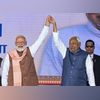
Prime Minister Narendra Modi and Bihar Chief Minister Nitish Kumar (Photo: PTI)
Listen to This Article
The year 2025 was marked by elections in key states, an unexpected vacancy in the Office of the Vice President, major legislative changes, and protests that defined India's political landscape. India also conducted a diplomatic outreach after 'Operation Sindoor', while the RSS marked its 100th year with national-level celebrations.
1. Delhi Assembly elections
Delhi voted for the 70-seat Assembly on February 5, with results declared on February 8. The Bharatiya Janata Party (BJP) returned to power in the national capital after nearly three decades, winning 48 seats. The Aam Aadmi Party (AAP) finished with 22 seats, and the Congress failed to win any.
BJP chose Rekha Gupta as the chief minister, and her swearing-in took place on February 20. The election campaign was dominated by AAP’s governance record -- unfulfilled promises on cleaning the Yamuna, persistent air pollution and water shortages. The liquor policy case, which led to former CM Arvind Kejriwal’s arrest and resignation, also weakened AAP’s position. The BJP ran an aggressive campaign through its Parivartan Yatra rallies, highlighting corruption charges against AAP leaders and promising welfare measures, including a monthly ₹2,500 scheme for women.
2. Bihar Assembly elections
Bihar went to polls in two phases on November 6 and 11, with counting held on November 14. The National Democratic Alliance (NDA) registered a sweeping victory, winning 202 of the 243 seats. The BJP won 89 seats, the JD(U) secured 85, and the LJP (Ram Vilas) bagged 19. The Mahagathbandhan managed just 35 seats, with Rashtriya Janata Dal (RJD) winning 25 seats and Congress six.
Nitish Kumar took oath as chief minister for a record 10th term, while Samrat Chaudhary and Vijay Kumar Sinha continued as his deputies. The Opposition's campaign centred on unemployment, youth migration, the demand for a caste census, and concerns over the deletion of more than six million names from voter rolls. On the other hand, the NDA projected welfare schemes by the Nitish government, such as the ₹10,000 monthly aid to women under the Mukhyamantri Mahila Rozgar Yojana.
Also Read

 "Government readies 'improved' IPR policy before PM Modi's US visit")

 "salary, pay, purse")
 "cars, auto industry")
 "ott service providers")
3. Vice President resignation and elections
On July 21, Jagdeep Dhankhar resigned as the Vice President, citing health concerns. Under the Constitution, this required an early election. Members of both Houses of Parliament voted on September 9.
The NDA candidate, CP Radhakrishnan, won the election with 452 votes, defeating the INDIA bloc's Justice (Retd) B Sudershan Reddy, who secured 300 votes. With 98 per cent turnout among electors, Radhakrishnan’s winning margin of 152 votes was the narrowest seen in over two decades. He was later sworn in as India’s 15th Vice President.
4. India’s diplomatic outreach after Operation Sindoor
After the Pahalgam terror attack on April 22, India launched 'Operation Sindoor' on May 7, targeting terrorist infrastructure in Pakistan-controlled territories. Four days of clashes ended on May 10, after which India began a major diplomatic campaign to explain its actions and counter international misinformation.
Seven all-party delegations were sent to partner nations across the Middle East, Europe, Africa, the US and Asia. The delegations included MPs from the ruling NDA, Opposition parties and senior diplomats. Their goal was to brief governments about India’s response to terrorism and promote a united national message.
Each delegation covered a key region, from Saudi Arabia and Bahrain to the UK, Japan, the US, Russia and South Africa, meeting political leaders and multilateral organisations such as the European Union.
5. Waqf (Amendment) Act, 2025
The Waqf (Amendment) Bill, aimed at reforming the 1995 Waqf Act, saw intense debate in Parliament. The Lok Sabha passed it on April 2 by 288-232 votes after a 12-hour discussion. The Rajya Sabha cleared it on April 4 by 128-95 votes after 17 hours of debate. President Droupadi Murmu gave her assent on April 5.
Prime Minister Narendra Modi called the law a “watershed moment”, while Home Minister Amit Shah said it would be enforced strictly. The new law brings several changes: compulsory inclusion of two non-Muslim members on Waqf boards, mandatory five-year adherence to Islam for donors creating Waqf, and giving district collectors authority to determine government claims over Waqf properties.
It also seeks to strengthen Waqf tribunals, formalise selection procedures, fix tenure, and reduce mandatory contributions from Waqf institutions from 7 per cent to 5 per cent. Properties earning over ₹1 lakh annually will undergo state-audited inspections.
The Bill faced strong opposition from several Muslim leaders. The Grand Mufti of Jammu and Kashmir, Mufti Nasir-ul-Islam, said the law “goes against Muslim interests” and noted the support of 232 MPs who voted against it. He also said they were considering approaching the Supreme Court.
6. RSS completes 100 years
The Rashtriya Swayamsevak Sangh (RSS), founded on October 10, 1925, marked its centenary year with large-scale events across the country. Prime Minister Narendra Modi attended the main event on October 1 at Delhi’s Dr Ambedkar International Centre, where he released commemorative stamps and coins.
Speaking about the commemorative coin and stamp, the PM said the ₹100 coin carried the National Emblem on one side and an image of Bharat Mata seated on a lion on the other. He noted that this was the first time Bharat Mata had appeared on Indian currency. The special postal stamp honoured the participation of RSS swayamsevaks in the 1963 Republic Day Parade.
7. Ladakh protests and the arrest of Sonam Wangchuk
Ladakh witnessed some of its most intense protests since it became a Union territory in 2019. Residents demanded statehood, Sixth Schedule protections and safeguards for land and jobs. The protests gained momentum through 2025, especially among younger people, and turned violent in late September.
On September 24 and 25, clashes with security forces left four people dead and around 90 injured. The unrest followed months of peaceful demonstrations, including a hunger strike by activist Sonam Wangchuk.
Wangchuk was arrested on September 26 under the National Security Act (NSA). Authorities accused him of “inciting violence” and “prejudicial activities”, and he was shifted to a Jodhpur jail. His arrest triggered national debates, legal petitions, and solidarity protests across India. Supporters said he had no intention of triggering violence and demanded an independent inquiry into the police firing.
More From This Section
 "Priyank Kharge (Photo: Wikipedia)")

 "Prime Minister Narendra Modi speaks in the Lok Sabha during a discussion on the 150th anniversary of the national song 'Vande Mataram'")
 "Parliament, Budget session, Lok Sabha")
 "Revanth Reddy")
Topics : Sonam Wangchuk Jagdeep Dhankar Bihar Election 2025 News Delhi Assembly Elections Bihar Assembly Elections Operation Sindoor Waqf Board RSS Ladakh BS Web Reports year ender 2025
Don't miss the most important news and views of the day. Get them on our Telegram channel
First Published: Dec 08 2025 | 4:04 PM IST