


Stablecoins risk currency substitution: RBI Deputy Governor T Rabi Sankar
RBI Deputy Governor T Rabi Sankar says rupee internationalisation aims to cut risk, not replace the dollar, as he flags stablecoin-linked currency substitution as a key threat
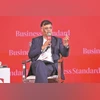 "T Rabi Sankar, Deputy Governor, Reserve Bank of India (Photo: Kamlesh Pednekar)")
T Rabi Sankar, Deputy Governor, Reserve Bank of India (Photo: Kamlesh Pednekar)
Listen to This Article
Internationalisation of Indian rupee is not to replace the dollar but to reduce risk for Indian businesses by enabling more transactions in rupees, Reserve Bank of India Deputy Governor T Rabi Sankar said in a fireside chat with Tamal Bandopadhyay during the Business Standard BFSI Insight Summit on Thursday. Edited excerpts:
The RBI has issued new norms for external commercial borrowing (ECB) and foreign exchange liberalisation -- on foreign currency borrowing by Indian companies -- removing cost caps, widening eligible borrowers and lenders, expanding end users, and raising the borrowing limit to 300 per cent. Why are we opening up so many things so fast?
These are not short-term measures. If you look at the RBI’s stance on capital account convertibility, we have consistently said that it is a process, not an event. In this spirit, we have been gradually liberalising the capital account. Today, barring a few constraints such as cost caps and amount limits on ECBs, most inward capital flows are liberalised.
What remains more under control is the extent of outward flows, which aligns with our stage of development. Regarding ECBs, we have taken several steps over the years to simplify processes, such as allowing derivative use and commodity hedging. Trade flows are also being liberalised as part of the effort to make foreign exchange transactions smoother and more convenient.
The current ECB proposals, still in draft form, aim to ensure that only financially strong entities borrow abroad. Instead of cost caps, we now link permissible borrowing to a firm’s leverage. Once this framework is finalised, cost caps and other limits may no longer be necessary. This is not a sudden move; it’s the continuation of a decades-long process of gradual liberalisation. We are still in the discussion stage and will finalise the framework after reviewing feedback, likely in the next couple of months.
Also Read

 "S Ramann, Chairperson, Pension Fund Regulatory and Development Authority (PFRDA) (Photos: Kamlesh Pednekar)")
 "RBI Deputy Governor T Rabi Sankar at BS BFSI summit in Mumbai on October 30, 2025.")
 "Poonam Gupta")
 "Poonam Gupta, RBI's Deputy Governor")
 "banks")
In the backdrop of global uncertainties, what would be the next stage of relaxations in terms of capital account convertibility, since the Indian rupee is only partially convertible on the capital account?
Trade is largely free, with only procedural requirements such as repatriation timelines. We have already released two draft proposals to simplify trade regulations, reducing over 100 directives to a single comprehensive framework. ECB liberalisation is part of this broader effort. Our priority remains on facilitating inflows of capital first, followed by calibrated outflows.
We start a policy and want to see results immediately. But many reforms take a long time to bear fruit. How do you see this in the context of internationalisation of the rupee?
Policy-making often involves preparing the ground for the future. Digital payments, for instance, took years after the introduction of two-factor authentication to really take off. Similarly, internationalising the rupee is a long-term process. The goal isn’t to replace the dollar, that’s unrealistic, but to reduce risk for Indian businesses by enabling more transactions in rupees. This reduces currency exposure for exporters and contributes to a more balanced global system where multiple currencies play a role. Over time, as India grows into a top global economy, the rupee must become more widely accepted in cross-border trade. We are creating the conditions for that transition, even if adoption takes time.
Despite all the talk, the Central Bank Digital Currency (CBDC) hasn’t really taken off. Where is CBDC today, and why should I use it if I already have UPI, which gives me interest on deposits while CBDC does not?
You’ve asked two questions — where CBDC is, and why CBDC. Let me take them one by one.
On the “where”: CBDC has been progressing as a pilot since 2022. We are not rushing it because most countries are still experimenting and studying its impact. Over 100 million transactions have taken place so far, but we are going slow to understand potential effects; for instance, whether CBDCs could replace bank deposits.
We are technologically ready, but our approach is cautious. We are also testing “programmable” CBDC use cases such as government benefits or education loans that can be spent only on specific items.
On the “why”: CBDC enables things that existing systems can’t, notably programmability and cross-border efficiency. Domestic payment systems like UPI work well, but cross-border transfers remain slow and expensive. CBDC can settle such transactions instantly and cheaply, without intermediaries. That’s why we see CBDC as uniquely useful, though the global understanding of token money is still evolving.
Is there any change in your approach to cryptocurrency, especially with stablecoins being legalised in some countries?
No, our stance remains unchanged. Both unbacked cryptocurrencies and stablecoins pose significant risks. Our analysis continues to show that cryptocurrencies do not serve any legitimate purpose that existing forms of money cannot serve better. Unbacked cryptos have no underlying cash flows or issuers, and hence, no intrinsic value.
Stablecoins, while backed, pose risks of currency substitution and loss of monetary sovereignty, especially for emerging markets like India. We believe CBDC can meet all legitimate use cases of stablecoins without those risks.
There’s some confusion in the payments space. For years we’ve had two-factor authentication, but now there’s an alternative authentication framework. Can you explain the new system?
Actually, we may not even have needed a regulation. Two-factor authentication has become synonymous with OTPs (one-time passwords), though technology now allows more secure alternatives. Fraudsters evolve, so authentication methods must evolve too.
The new framework allows flexibility; OTP remains valid but is no longer the only option. The idea is to encourage innovation and better security as technology evolves.
On foreign exchange reserves, the RBI has churned a substantial portion in recent years, making profits by selling old holdings and buying at higher prices. With the old stock depleting, will your ability to generate profits and pay dividends to the government reduce?
Yes, if earnings change, surplus transfers will also change. But that’s incidental. The central bank doesn’t operate with profit as an objective. Surplus transfers come mainly from seigniorage income, which belongs to the people and is rightly passed on to the government.
As for valuation, we follow standard accounting practices: holdings are recorded at average acquisition cost, and profits or losses are booked against that. So even though the average cost rises over time, it balances out. Depending on exchange rate movements, sales can yield either profit or loss.
More From This Section
 "BS BFSI SUmmit")
 "(L-R) NAVEEN CHANDRA JHA, MD & CEO, SBI General Insurance; YASHISH DAHIYA, Chairman & Group CEO, PB Fintech; TAPAN SINGHEL, MD & CEO, Bajaj General Insurance and ANUP RAU, MD & CEO, Generali Central Insurance (PHOTOs: KAMLESH PEDNEKAR)")
 "(From left) Rahul Jain, president and head, Nuvama Wealth; Anas Rahman Junaid, founder and chief researcher, Hurun India; Rajesh Saluja, managing director, ASK Private Wealth; and Srikanth Subramanian, co-founder and CEO, Ionic Wealth")
 "(L-R) H P Singh CMD, Satin Creditcare; Sadaf Sayeed, CEO, Muthoot Microfin; Alok Misra, CEO, MFIN and Karthik Srinivasan, Group Head, Financial Sector Ratings, Icra")
 "(L-R) Debashish Banerjee, partner, Deloitte India; Sharad Mathur, MD & CEO, Universal Sompo General Insurance; Narendra Bharindwal, president, IBAI, and Amit Roy, partner and leader, PwC India")
Topics : Reserve Bank of India Business Standard BFSI Summit BFSI bs events cryptocurrency digital currency Indian rupee
Don't miss the most important news and views of the day. Get them on our Telegram channel
First Published: Oct 31 2025 | 12:08 AM IST