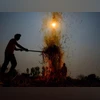
Stubble Burning
Are farm fires really falling? Evening stubble burning puts counts in doubt
Official figures show a sharp decline in stubble-burning incidents, but evening fires may be escaping satellite detection. An October study by the Council on Energy,


Stubble burning numbers fall sharply, but satellite blind spots cloud data
Official data shows a sharp decline in farm fires across Punjab and Haryana, but studies and field reports suggest farmers are shifting burning to evening hours, when satellites may miss incidents

Datanomics: Delhi's AQI improves after hitting 5-year high on Diwali
Delhi records a five-year high in Diwali pollution despite GRAP restrictions, with secondary particulate matter emerging as the biggest contributor

Paddy stubble burning falls 26.6% in 7 states; Punjab records most cases
Paddy stubble burning incidents fell 26.63% to 3,316 across seven states between September 15 and November 1, with Punjab accounting for nearly half the cases.
A singular approach
Pollution-control plans must be coordinated across north India

Statsguru: Don't blame stubble burning alone for poor air quality
Farm fires are seasonal, but year-round emissions from power plants and persistently high PM2.5 levels underline the need for a broader clean-air strategy

Centre asks 5 states to go on 'mission mode' against stubble burning
Ministers urged states to step up monitoring, repair idle machines and offer farmers affordable alternatives as stubble burning incidents rose sharply in MP and Rajasthan

Air as an electoral issue: Cricket pullouts may push action in North India
Foreign cricket teams refusing to play in North India could spur government to act

Satellites missing most farm fires in Punjab and Haryana, says report
More than 90 per cent of large farm fires in Punjab and Haryana are now going undetected by the official monitoring systems as farmers are shifting stubble-burning activities to late afternoons, according to a new analysis published on Monday. The Stubble Burning Status Report 2025 by the International Forum for Environment, Sustainability and Technology (iFOREST) said this led to major underestimation of the contribution of stubble burning to Delhi's air pollution this year. iFOREST said the government's current monitoring protocol, run by the Consortium for Research on Agroecosystem Monitoring and Modeling from Space (CREAMS) of the Indian Agricultural Research Institute, is unable to detect most farm fires as it relies mainly on polar-orbiting satellites that observe India only between 10:30 am and 1:30 pm. This narrow time window no longer matches farmers' burning practices, it said. At the same time, the report finds real progress on the ground, with burnt areas in Punjab and

'Pollution in Delhi nearly doubled in Nov, becoming 4th most polluted city'
Delhi's air pollution nearly doubled in November, pushing the national capital to the fourth spot among the most polluted cities in the country, according to a report. A report released by the Centre for Research on Energy and Clean Air (CREA) on Saturday highlighted that while the impact of stubble burning on Delhi's air quality was significantly lower compared to last year, pollution levels in the city remained severe. Delhi ranked as the fourth most polluted city in the country in November, recording a monthly average PM2.5 level of 215 micrograms per cubic metre -- nearly double its October average of 107 micrograms per cubic metre. The national capital witnessed 23 'very poor' days, six 'severe' days and one 'poor' day during the month. Despite the deteriorating air quality, the contribution of stubble burning averaged only 7 per cent in November, compared to 20 per cent last year. Peak stubble-burning contribution touched 22 per cent, significantly lower than the 38 per cent

Incidents of paddy stubble burning down sharply 13% in 2025, shows data
In Haryana, the number has come down by a similar percentage to just 659
UP govt suspends 9 officials in Maharajganj as stubble burning cases rise
Maharajganj administration has suspended nine lekhpals for alleged negligence over continuous rise in stubble burning cases, officials said on Tuesday. Show-cause notices have also been issued to the sub-divisional officers of four tehsils, the deputy director of agriculture and station house officers of several police stations, they said. Notices have additionally been sent to multiple village heads. According to the officials, 40 combine harvesters found violating paddy-cutting guidelines have been seized, and fines amounting to several lakhs of rupees was imposed. Maharajganj currently tops Uttar Pradesh in stubble burning incidents, with 380 cases recorded so far. Despite awareness campaigns and intensified enforcement, officials said the expected decline in cases has not been observed. District Magistrate Santosh Kumar Sharma has been holding daily review meetings with officials to devise strategies to curb the practice, given the environmental and health hazards associated
Stubble burning incidents decline in Delhi-NCR, Punjab, Haryana: Agri secy
Stubble burning incidents in Delhi-NCR, Punjab and Haryana have reduced this year due to government support for farm machinery and other measures, Agriculture Secretary Devesh Chaturvedi said on Monday. The government has provided farmers with relevant equipment and necessary interventions to tackle the problem, Chaturvedi told reporters on the sidelines of an event. "Certainly...because of the policy of providing machineries and in-situ and ex-situ measures, the incidents of stubble burning in Delhi-NCR, Punjab and Haryana have reduced," he said. There have hardly been incidents of stubble burning in the last ten days, he said. Stubble burning by farmers in northern India after harvesting has been a major contributor to severe air pollution in Delhi and surrounding areas during winter months. When asked about other pollution sources, Chaturvedi said other ministries were better placed to comment. "If there are other reasons (for pollution), other ministries are best to say," he
Stubble burning incidents fallen due to machinery support: Agri secy
Stubble burning incidents in Delhi-NCR, Punjab and Haryana have reduced this year due to government support for farm machinery and other measures, Agriculture Secretary Devesh Chaturvedi said on Monday. The government has provided farmers with relevant equipment and necessary interventions to tackle the problem, Chaturvedi told reporters on the sidelines of an event. "Certainly...because of the policy of providing machineries and in-situ and ex-situ measures, the incidents of stubble burning in Delhi, NCR, Punjab and Haryana have reduced," he said. There have hardly been incidents of stubble burning in the last ten days, he said. Stubble burning by farmers in northern India after harvesting has been a major contributor to severe air pollution in Delhi and surrounding areas during winter months. When asked about other pollution sources, Chaturvedi said other ministries were better placed to comment. "If there are other reasons (for pollution), other ministries are best to say," he

Is air pollution just a winter issue? These myths put your health at risk
From masks and plants to Diwali and ACs, pulmonologists break down the myths standing in the way of clean air and better health

MP set to take 1st spot from Punjab in stubble-burning, reports 1,052 fires
Madhya Pradesh logged 1,052 stubble-burning incidents in a single day, taking its season total to 3,569 between September 15 and November 11, placing it just behind Punjab's 4,507 cases
SC seeks report from Punjab, Haryana on stubble burning, air pollution
The Supreme Court has asked Punjab and Haryana to detail steps taken to curb stubble burning as Delhi's air quality worsens, with the court set to hear the matter again on Monday

Stubble burning in Punjab, Haryana worsening Delhi-NCR AQI: Supreme Court
Stubble burning has commenced in a big way with impunity in Punjab and Haryana leading to further worsening of air quality levels in Delhi-NCR, the Supreme Court was told on Tuesday. A bench headed by Chief Justice B R Gavai, which is scheduled to hear the air pollution case on Wednesday, was urged by senior advocate Aprajita Singh, who is assisting the bench as an amicus curiae, that a response be sought from the governments of Punjab and Haryana. Singh referred to NASA satellite images to buttress her point that stubble burning in these two states has commenced and it is contributing to already severe air pollution levels in Delhi-NCR. "The apex court orders are being flouted with impunity," she said, adding that these states should respond to the present situation. "We will pass some orders on Wednesday," the CJI said. Earlier on November 3, the top court directed the Commission for Air Quality Management (CAQM) to file an affidavit detailing the steps it has taken so far to ..
Punjab sees 3,284 stubble burning from from Sep to Nov, Haryana records 206
CAQM undertook field visits in Punjab to assess the ground situation related to crop residue management and enforcement activities aimed towards the reduction in stubble burning incidents
Punjab records 283 stubble burning cases, highest single-day spike
Punjab on Wednesday saw the season's highest single-day spike in stubble burning with 283 instances, official data showed. The latest addition took the total farm fire count since September 15 to 1,216. Tarn Taran, Amritsar, Sangrur and Ferozepur districts accounted for the bulk of crop residue burning cases, according to Punjab Pollution Control Board (PPCB) data, as many farmers continued to disregard the state government's appeal to not set the crop residue on fire According to the data, the highest farm fire incidents were reported from Tarn Taran at 296, followed by Amritsar, 173, Sangrur, 170, Ferozepur, 123, Patiala, 73, Bathinda, 61, and Kapurthala at 48. Stubble burning in Punjab and Haryana is often blamed for the rise in air pollution in Delhi-NCR. As the window for the Rabi crop, wheat, is very short after paddy harvest in October-November, some farmers set their fields on fire to quickly clear off crop residues. According to PPCB data, the total area under paddy ...