


'UK is back on world stage': Keir Starmer after trade deal with India
The trade deal comes at a time when US President Donald Trump's tariff policies continue to disrupt global trade
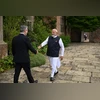 "Modi Starmer")
The deal signed earlier Thursday by the Indian and British trade ministers eliminated or reduced a swath of tariffs and lifted other barriers to commerce. | Credit: Bloomberg


Listen to This Article
By Lucy White
The UK has restored its international standing after years of “performative” politics under successive Conservative governments, Labour Prime Minister Keir Starmer said in an interview after sealing a long-sought trade deal with India on Thursday.
The trade deal — the biggest struck by Britain since Brexit — will cut the vast majority of India’s tariff lines for the UK, helping exports from Scotch whisky to cars. But speaking at his Chequers country retreat after meeting with Indian Premier Narendra Modi, Starmer said the agreement didn’t mark the limit of the UK’s ambition, and would provide a baseline of cooperation to build on for the two countries.
“We have re-established the place and position of the UK on the world stage,” Starmer told Bloomberg in his only interview with a major publication to mark crystallisation of the pact, referring also to increased cooperation with the European Union and a trade pact with the US. Now, “we’re seen as a country which other countries want to be working with and delivering with.”
The deal signed earlier Thursday by the Indian and British trade ministers eliminated or reduced a swath of tariffs and lifted other barriers to commerce. The pact came after three years of intense negotiations touching on thorny topics such as visas, and tax breaks. The two nations concluded talks in May, completing Britain’s biggest trade deal since Brexit and India’s most significant such agreement to date.
Also Read

 "Narendra Modi, Keir Starmer")
 "Britain's Prime Minister Keir Starmer and Prime Minister Narendra Modi")
 "Modi, Narendra Modi, Keir Starmer")
 "Modi, Narendra Modi, Keir Starmer, Keir, Starmer, UK")
 "Modi, Narendra Modi, Keir Starmer, Keir, Starmer, UK")
“This isn’t merely paving the way for economic partnership but is also a blueprint for our shared prosperity,” Modi said earlier Thursday, speaking alongside Starmer at Chequers.
In an interview with Bloomberg on Thursday evening, Modi’s trade minister, Piyush Goyal, said the deal will “open the doors for more robust and resilient supply chains,” as well as encouraging “greater investments because of the stable and predictable business environment.”
“It’s a win win for both UK and India,” he said.
A separate bilateral investment treaty is still being negotiated between the UK and India, which could include more controversial elements such as a provision which allows investors to sue either government if they believe a policy change has unfairly affected their profits. “I do hope we will get that also across the hump soon,” Goyal said of the treaty, declining to discuss the sticking points.
The trade deal comes at a time when US President Donald Trump’s tariff policies continue to disrupt global trade, and Starmer told Bloomberg that it marked “a real statement of intent as to how close we want our two countries to be as we go forward in an uncertain world.” He added that he and Modi had already begun to discuss which areas they could build on.
Starmer, whose Labour Party was elected to power a year ago, also made a jibe at his Tory predecessors Boris Johnson and Rishi Sunak — both of whom set and missed their own deadlines for agreeing a deal with India, with the former famously promising one by Diwali 2022.
“Serious, pragmatic, respectful diplomacy trumps performative politics any day of the week,” Starmer said. He added that the “quiet, serious, pragmatic, respectful way” in which he had asked officials to proceed “achieved results compared with the noisy performance of my predecessors.”
Starmer and Modi earlier attended a showcase of businesses who hoped to benefit from the trade deal. Representatives from firms including the supermarket chain Sainsbury’s and family-run Spice Kitchen staffed stands under a marquee in the Chequers rose garden, and said they were excited about the opportunities for further cooperation between the UK and India.
“We import a lot from India,” said Spice Kitchen’s Sanjay Aggarwal, who runs the business with his mother Shashi. “Hopefully some of our costs will come down.” Starmer had said he “loves to cook and loves Indian food,” Aggarwal added.
For Modi, the deal reinforces his push to position India as a viable alternative for global supply chains looking to diversify. The pact — India’s first major one in a decade — signals that the South Asian nation is willing to lower its barriers to attract investments as it negotiates a bilateral trade deal with the US. It will also act as a springboard for India’s ongoing talks with European Union.
For Starmer, the deal will be a welcome step toward his goal of boosting economic growth in the UK. While it is expected to add £4.8 billion ($6.5 billion) to the UK’s annual economic output — a tiny increase to the size of the economy — Starmer’s Labour government hopes successive incremental wins will help encourage investment and turn around lackluster business sentiment.
With Trump due to arrive in Scotland on Friday for a personal visit during which he’ll meet with Starmer, the signing comes as Britain works to flesh out the trade pact it agreed with the US. Meanwhile the New Delhi administration is racing to clinch a deal with Washington before Aug. 1, when higher tariffs are due to kick in.
(Only the headline and picture of this report may have been reworked by the Business Standard staff; the rest of the content is auto-generated from a syndicated feed.)
More From This Section
 "Gaza protest")
 "Hulk Hogan")
 "china european union, china EU,")
 "Donald Trump, Trump")
 "Thailand Cambodia military tension")
Don't miss the most important news and views of the day. Get them on our Telegram channel
First Published: Jul 25 2025 | 12:35 AM IST