


Lunch with BS: Dipankar Gupta
An idea for India
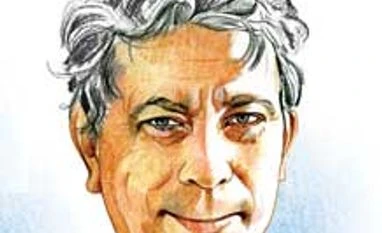 "Dipankar Gupta")
Anthony Bourdain?" asked the senior art director of the photos illustrator Binay Sinha was viewing for the sketch of Professor Dipankar Gupta that accompanies this piece. There is a superficial resemblance sure, but the contrast between the travel chef's boisterous TV persona and the respected sociologist's low-key personality couldn't be more stark, writes Kanika Datta.
We're meeting at the Smoke House Deli in the luxurious Promenade Mall that has come up opposite Jawaharlal Nehru University, where Gupta taught for almost 30 years. Maybe it was my enthusiastic endorsement of the liver pate and steaks that made him agree to Smoke House. His appetite is startlingly frugal - shared soup and salad, half a sandwich and a smidgeon of a splendid walnut prune pie with cream. And no wine, thanks, so we have fresh pineapple juice.
Gupta's latest book Revolution from Above: India's Future and the Citizen Elite has received approving reviews, though the central point - that it is a "citizen elite" that plays a critical role in shaping progressive public policy - may be too subtle for the ideologues who dominate the political discourse these days. Unusually for a Bengali, he speaks Hindi comfortably with the waiter, the legacy of a peripatetic childhood because his father worked with the Reserve Bank. But it was Bombay, as it was then known, where he says he spent the best days of his life.

Bombay, then as now a city of migrants, was also where he did his PhD, working with the Shiv Sena. "More than anything else, I do believe the Shiv Sena was waiting to happen," he says as our half-bowls of Tomato Bocconcini Tortelli soup arrived, a clear broth delicately flavoured with basil and ginger. "There was a middle class who resented the status of Bombay because it felt the Marathi language and culture wasn't given the eminent status it deserved."
And what did he make of Bal Thackeray? "After initial problems, Thackeray was very good to me," he replies, then adds thoughtfully, "The man was from a middle-class background, he was quite ill at ease in somewhat spiffier circles and he wasn't terribly clever. There was some class/cultural antagonism as well. He believed, like most people, that Pakistanis, Muslims, Communists etcetera are bad, but at that time south Indians were the worst and the Marathis were being done in by that segment."
Still, given the Manichean world view to which young people are prone, what surprised him then was that "the Shiv Sainiks are normal, they don't have fangs!" Yes, he elaborated, they hated Muslims, etcetera "but they were also good fathers and sons, good friends even. They were life insurance agents and bank clerks. But they also had this side to them, though they don't think there's anything wrong. In fact, they thought the Shiv Sainiks were a cultural organisation doing something good for Marathi culture."
What about the thuggery, I ask sceptically. "No doubt there were bad elements and they kept increasing in number. Thackeray wanted them there because it gave his units a striking power. But when I told Shiv Sena supporters about this, they say oh, that's untrue - you believe what you want to."
A succulent grape and asparagus salad is served, the balsamic dressing nicely balanced. But the salad is bulked out with Chinese cabbage leaves cut so clumsily that we struggle to fork them up. From seminars I attended I recall him agreeing with Andre Beteille's aversion to field work. He admits as much but adds, "my work has been on the edgy part of my interests in research - Sikh militancy, peasant uprisings and so on."
Which meant much of this fieldwork was in what is now Jharkhand, Chhattisgarh and parts of Bihar. And "although it was tough physically, I used to come home at ease with myself because of what I'd done and learnt. For instance, I learnt a lot about the generosity of very poor people. Also, in the field, don't put on an act. I found when I stopped trying to be a villager, it worked. For instance, I said I wouldn't drink the water. They would laugh and say, this man only drinks tea and sometimes they would pool their hard-earned money and buy me a Campa Cola."
We're laughing about the discomforts of field work, the mosquitoes and sounds of early morning ablutions and expectoration, when he turns sober. "The only place I was told by the hosts that they would not give me tea was in Gujarat when I was studying riot victims" - the subject of his 2011 book Justice Before Reconciliation. "This was in a Muslim settlement colony. The place was truly horrible, and the people I interviewed said they wouldn't make me tea because the water there was very bad."
Our waiter places a small, no tiny, toasted Balsamic Chicken sandwich in front of Gupta. In front of me is a large platter on which a tenderloin steak reposes, garnished with roast potatoes and sauted vegetables. I am appalled at the contrast and earnestly suggest he order something else. No, he insisted this was more than enough, so we set to and I ask how he came to be a sociologist.
It turned out that he was planning to be a policeman. That was because his uncle - "the man I admired the most" - was a policeman in Bihar and "I could think of no better life"; it seemed to have involved jeep drives through the Hazaribagh forests on shikars.
Being underage to take the IPS exams, he decided to do an MA from Delhi University in the interim. He opted for English literature "but then I went to D-School [the Delhi School of Economics] and found the syllabus in sociology attractive, so I signed up, thinking I'll be a policeman in one year anyway. My name was on the third list."
"I remember Srinivas [M N, one of India's pioneering social anthropologists] asking me whether I wanted to be an IAS officer - many people did and he didn't like that. I could honestly say no. IAS was not on my radar - I wanted to wear a uniform, go out in jeeps!"
Then, within six months "I met all those madcaps and changed my mind". He remembers the socialising between the departments of economics and sociology. "I don't know what Amartya Sen is like now but he kept the most open-door policy I have encountered - and he was an excellent teacher."
Naturally, the talk turns to the Sen-Bhagwati spat. He shakes his head, "Two old men, past their prime…" Maybe if someone gave Bhagwati a Nobel it would all die down, I suggest. He shakes his head again. "What Amartya says and does now is immaterial - even I have problems with that - but he deserved the Nobel hands down. Jagdish is not in the same league. He is very good but Amartya is scintillating."
His problem now is that "Amartya is putting a lot of energy into redistribution rather than in upskilling and his constant reference to the Kerala model - I have been there and it is not God's Own Country. It is not industry-efficient, has no use for its literate population, there's high alcoholism and suicide rates."
The talk turns to his latest book. How did he define "a citizen of calling"? "Consider the two main figures of Indian independence, Nehru and Gandhi. Both had their flaws but did things for democracy in ways that did not serve their self-interest but the cause of citizenship."
He warms to his subject as he waits for me to finish my steak. "They did what they thought was right and didn't ask people what they thought either. I mean, if Gandhi had asked people whether they wanted to remove untouchability, the majority would have said no. But he packaged it with so many other things that it was difficult to turn down. And Nehru packaged his beliefs with developing India - dams, steel mills, doctors, engineers. So while others had only anger and hurt, Nehru was the only one who had things to offer."
The notion of a "citizen elite", he admits as dessert is served, was something he was not ready for. "All my schooling, my political beliefs said things bubbled up from below and somebody would take them forward. Then I realised, to my horror, that people do not always know in general what's good for them - to be able to think beyond the given does not come naturally to them."
Take the abolition of the zamindari system, he points out. What the peasantry actually wanted was a reduction of rents. Anti-landlordism was an upper-class movement by those who were aware of the progress in Europe after the end of feudalism.
And no, he says in response to my obvious question over coffee, there is no sign of a citizen elite in India, though there are elements of noblesse oblige. "But that's because democracy hasn't moved forward in the world for the last 50 years." The stagnation of democracy, he thinks, is a result of the Cold War. But that discussion would take up another article. Or perhaps another book.
Don't miss the most important news and views of the day. Get them on our Telegram channel
First Published: Aug 16 2013 | 10:32 PM IST