


'Low-quality deal': NZ foreign minister slams India-New Zealand FTA
New Zealand's Foreign Minister Winston Peters has called the India-New Zealand FTA a "low-quality deal", criticising its impact on dairy, labour mobility and migration
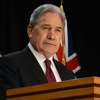 "New Zealand's Foreign Affairs Minister Winston Peters")
Winston Peters is the leader of the New Zealand First party, which is a part of the ruling right-wing coalition government led by Luxon's National Party. (Photo: X/@NewZealandMFA)
Listen to This Article
India and New Zealand finalised a free trade agreement (FTA) on Monday, with Prime Minister Narendra Modi and his Kiwi counterpart Christopher Luxon calling it a "historic" deal that will provide increased market access and boost the economy.
The excitement, however, was not shared by New Zealand's Foreign Affairs Minister Winston Peters, who called it a "low-quality" deal, which threatens New Zealand's agriculture and labour market.
The deal provides India with duty-free access to New Zealand's market, while Wellington gains a reduction of tariffs on 95 per cent of its exports. It, however, excludes access to India’s politically and economically sensitive dairy sector and some farm products, reflecting New Delhi’s firm stance on these sectors.
"We consider the India-New Zealand Free Trade Agreement to be neither free nor fair. Regrettably, this is a bad deal for New Zealand. It gives too much away, especially on immigration, and does not get enough in return for New Zealanders, including on dairy," Peters said in a post on X.
Also Read

 "Ed Sheeran")
 "holiday travel health tips")
 "artificial intelligence, AI,")
 "Piyush Goyal")
 "green card, h1b visa")
New Zealand First is regrettably opposed to the India Free Trade Agreement announced today. We consider the India-New Zealand Free Trade Agreement to be neither free nor fair. Regrettably, this is a bad deal for New Zealand. It gives too much away, especially on immigration,…
— Winston Peters (@winstonpeters) December 22, 2025
Peters is the leader of the New Zealand First party, which is a part of the ruling right-wing coalition government led by Luxon's National Party.
He further claimed that the National Party rushed to do a low-quality deal and avoided doing the hard work necessary to get a fair deal that delivers for both New Zealanders and Indians.
"While New Zealand is completely opening its market to Indian products under this deal, India is not reducing the significant tariff barriers currently facing our major dairy products. This is not a good deal for New Zealand farmers and is impossible to defend to our rural communities," Peters said.
He added: "The India FTA would be New Zealand’s first trade deal to exclude our major dairy products - including milk, cheese and butter. In the year to November 2025, New Zealand exports of these products were worth around $24 billion, or 30 per cent of our total goods exports".
While New Zealand is one of the world's largest dairy exporters, its exports to India have been mostly humble. In the financial year 2024-25 (FY25), New Zealand's dairy exports to India stood at just $1.07 million, comprising milk and cream ($0.40 million), natural honey ($0.32 million), mozzarella cheese ($0.18 million), butter ($0.09 million) and skimmed milk ($0.08 million), reported PTI.
Unwise deal for Kiwi jobs: Peters
Peters also raised concerns over provisions related to labour mobility and migration, arguing that they went beyond the scope of two-way trade. He said the government had made "serious concessions to India" that encouraged the movement of people from India to New Zealand and New Zealand's investment in India.
Under the deal, New Zealand will offer 1,667 three-year skilled work visas annually to Indian professionals in multiple sectors, alongside 5,000 temporary entry visas and 1,000 work-and-holiday permits. The deal also includes a commitment by New Zealand to raise foreign direct investment in India to $20 billion over 15 years.
"On a per capita basis, National has offered far greater access for India to our labour market than did Australia or the United Kingdom to secure their FTAs. This is deeply unwise given New Zealand’s current labour market conditions, with too many New Zealanders in unemployment or doing it tough economically," he said.
He added that the creation of a new employment visa specifically for Indian citizens was likely to generate increased migration interest "at a time when we (NZ) have a very tight labour market". Peters also warned that expanded work rights for Indian students could constrain future governments’ ability to adjust policy in response to changing economic conditions.
The deal now awaits parliamentary approval in New Zealand. Peters said his party, which has eight MPs in the 123-member House of Representatives, will vote against it when introduced.
Despite opposing the deal, Peters stressed that New Zealand First’s stance was not a criticism of India or its negotiators. "Our opposition to the deal is not a critique of the Government of India or its negotiators – but rather the reflection of a difference of opinion between the parties that comprise New Zealand’s Coalition Government," he said.
He reiterated his party’s commitment to strengthening India–New Zealand relations, calling them strategically important, and said he had conveyed New Zealand First’s position directly to India’s External Affairs Minister S Jaishankar.
More From This Section
 "Yogi Adityanath, yogi, UP CM")
 "MGNREGA")
 "Manjinder Singh Sirsa")
 "Sukhbir Singh Badal, SAD")
Don't miss the most important news and views of the day. Get them on our Telegram channel
First Published: Dec 22 2025 | 4:09 PM IST