


Buying a car in Maharashtra? Proof of parking space may soon be mandatory
If you can't park it, you can't register it. Maharashtra government is likely to mandate proof of parking space for new vehicle registrations; aims to curb congestion and illegal parking in cities
 "Traffic, Traffic jam, New Delhi Traffic Jam")
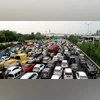
Proof of a parking space will now be required to register a car. (Photo: PTI)
Listen to This Article
Car buyers in Maharashtra may soon need more than just money and paperwork — a parking space will be a must. In a move aimed at addressing the growing parking challenges and worsening traffic congestion in the Mumbai Metropolitan Region (MMR), Minister of Transport Pratap Sarnaik on Monday announced that buyers will need to provide proof of an allotted parking space to register new vehicles.
The directive, part of a broader parking policy under discussion, was shared following a high-level meeting held to finalise the state’s strategy for managing urban space more effectively.
Developers must provide parking spaces, says minister
“We are looking to construct parking spaces. Development rules should be followed, and developers must provide parking with flats. We will not register new vehicles if the buyer doesn’t have a certificate of parking space allotment from the concerned civic body,” said Sarnaik, underlining the government’s focus on responsible urban development.
Highlighting the acute shortage of parking across the MMR, the minister revealed that the Urban Development Department is working on a proposal to allow construction of parking facilities beneath designated recreational grounds. The move is expected to help create more parking space without disrupting the city’s green cover.
Also Read

 "Chhagan Bhujbal")
 "college, students")
 "BR Gavai, Bhushan Ramkrishna Gavai, Bhushan Ramkrishna, Ramkrishna Gavai, CJI")
 "court, dispute, court order")
 "Modi, Narendra Modi")
Pod taxi network in the works
Sarnaik also spoke about Maharashtra’s plans to introduce a pod taxi system as part of its efforts to improve urban mobility. “A presentation on the pod taxi project was made to me. I have visited Vadodara, which is set to host the world’s first commercially ready suspended pod-car transport system,” he said.
He added that the state is considering similar pod taxi networks in Mira-Bhayandar and the Bandra-Kurla Complex (BKC) to improve last-mile connectivity with the metro network.
'Proof of parking space' needed in Maharashtra: How will the policy be implemented?
The transport department will conduct surveys to identify and catalog available parking spaces, assigning unique identifiers to each spot. When registering a new vehicle, the buyer must link their vehicle registration to an approved parking space, The Indian Express reported.
This approach ensures that the number of vehicles in a locality does not exceed the available parking infrastructure, reducing illegal street parking and traffic congestion.
Similar policies in India
Chennai has introduced a parking policy recommending mandatory proof of parking for new vehicle registrations. Aimed at curbing private vehicle use, the plan includes a parking management unit, designated zones, and variable fees. The initiative promotes responsible car ownership and encourages public transport to enhance urban livability.
Bengaluru and Delhi have also debated similar measures in recent years, reflecting a nationwide recognition of the need to address parking-related urban challenges. However, experts caution that implementation will require significant coordination between civic bodies, transport departments, and urban planners. They also highlight the risk of fraudulent documentation and the challenges posed by unplanned urban areas and unauthorised colonies, news agency PTI reported.
Global parking rules reshape car ownership
Japan
Japan’s ‘proof of parking’ rule (Shako Shomei Sho) requires car buyers to obtain a ‘Parking Space Certificate’ from local police before registration. Especially enforced in cities like Tokyo, it curbs illegal parking and limits car ownership. Buyers must prove access to nearby off-street parking through a verified process.
Vietnam
Experimented with proof-of-parking but discontinued the requirement due to concerns about corruption. The city later introduced a smart parking system to help motorists find and pay for parking.
China
Beijing announced plans for a policy requiring residents to show proof of access to a parking spot before being allowed to purchase a car. The rule aims to address severe traffic congestion and parking shortages.
Singapore
Strict vehicle ownership controls include high registration fees and a Certificate of Entitlement (COE) system. While not always requiring parking proof, new developments must meet stringent parking requirements, and public parking is tightly regulated.
[With agency inputs]
More From This Section
 "Rain, Shimla Rains, monsoon")
 "Accident, road accident")
 "M")
 "Rain, Rainfall, monsoon")
 "Vande Bharat, all women crew, international womens day, central railway")
Topics : Maharashtra Mumbai Traffic jam Mumbai traffic Delhi traffic BS Web Reports Chennai Japan congestion
Don't miss the most important news and views of the day. Get them on our Telegram channel
First Published: May 20 2025 | 1:09 PM IST