


Putin's India visit: Why New Delhi won't act on the ICC arrest warrant
As Vladimir Putin visits India, the ICC arrest warrant resurfaces, but New Delhi faces no legal duty to detain him since India is not a Rome Statute signatory
 "Droupadi Murmu, Murmu, President, Vladimir Putin")
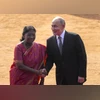
New Delhi: President Droupadi Murmu with Russian President Vladimir Putin during a ceremonial reception and Guard of Honour at the Rashtrapati Bhavan in New Delhi, Friday, Dec. 5, 2025.(Photo: PTI)
Listen to This Article
Russian President Vladimir Putin’s two-day state visit to India began with full diplomatic ceremony on Thursday. On Friday morning (December 5), he received a tri-services guard of honour at Rashtrapati Bhavan in the presence of President Droupadi Murmu, with Prime Minister Narendra Modi, External Affairs Minister S Jaishankar and Chief of Defence Staff General Anil Chauhan in attendance. PM Modi personally welcomed Putin at the airport with a warm hug and a firm handshake on the evening of December 4.
But Putin’s visit to India has also raised a familiar question: what happens to the International Criminal Court’s (ICC) arrest warrant against the Russian president? The optics of the visit are striking, as one of the ICC’s most high-profile accused is stepping onto the soil of one of the world’s largest democracies, a country that maintains strategic ties with Moscow while deepening engagement with the West.
Yet the legal position is straightforward: India has no obligation to detain him. So what does the warrant actually say, and how do global arrest obligations work in practice?
What does the ICC warrant against Putin say?
The ICC issued a warrant against Russian President Vladimir Putin in March 2023, alongside one for Russia’s children’s commissioner, Maria Lvova-Belova, accusing them of unlawful deportation and transfer of Ukrainian children from occupied areas of Ukraine to Russia. The warrants ask ICC member states to arrest the named individuals if they travel to their territory.
Prosecutors alleged that hundreds of Ukrainian children were deported and relocated to Russia or Russian-controlled territory in violation of international law. The ICC’s pre-trial chamber concluded there were reasonable grounds to issue arrest warrants for Putin and Lvova-Belova in relation to these acts. The ICC prosecutor filed the request after investigations into the situation in Ukraine. Russia rejects the court’s authority and has called the move politically motivated.
Also Read

 "indigo airlines, indigo")
 "Modi, Narendra Modi, Vladimir Putin, putin")
 "WHO malaria report 2025")
 "real estate construction building")
 "Indian passport")
Why is India not legally bound to detain Putin during his visit?
The key reason is that India is not a party to the Rome Statute. It neither signed nor ratified the treaty that created the ICC and set out states’ obligations to arrest and surrender suspects. The Rome Statute provisions that require states to execute ICC arrest requests apply to states that have ratified the treaty. A non-party state therefore has no treaty obligation under the Rome Statute to arrest ICC-listed individuals who enter its territory. Essentially, the ICC can request cooperation, but it cannot compel a country that has not accepted its jurisdiction.
Therefore, the arrest warrant has no automatic legal effect inside India. India has no treaty obligation to detain or surrender Putin if he sets foot on Indian soil. The decision to arrest or not would be political, not a matter of enforced legal duty.
In the past as well, when the ICC’s warrant targeted former Sudanese president Omar al-Bashir, India hosted him in 2015 despite calls for his arrest.
What is the ICC?
The ICC, based in The Hague in the Netherlands, is a permanent international court created by the Rome Statute (in force since 2002) after ratification by 60 states. Its main purpose is to investigate and prosecute genocide, crimes against humanity, war crimes and the crime of aggression when national courts are unwilling or unable to act.
An ICC arrest warrant is a judicial order issued by ICC judges when the court’s pre-trial chamber finds there are reasonable grounds to believe a person has committed crimes within the court’s jurisdiction. It tries individuals, not states, but does not have its own police force. Therefore, it depends on member states for arrests and cooperation.
Who are other prominent figures with ICC warrants?
The court has issued arrest warrants in other high-profile cases. For example, former Sudanese president Omar al-Bashir (warrant 2009) and long-time fugitive Joseph Kony, leader of the Lord’s Resistance Army in Uganda (warrant 2005), are on the list.
More recently, Israel’s Prime Minister Benjamin Netanyahu was alleged to be responsible for the war crime of starvation as a method of warfare and for intentionally directing an attack against the civilian population in Gaza. The ICC has also accused Netanyahu of crimes against humanity, including murder, persecution and other inhumane acts, from at least October 8, 2023, until at least May 20, 2024.
More From This Section
 "Supreme Court, SC")
 "gavel")
 "Loudspeaker ban")
 "Supreme Court, SC")
 "Supreme Court, SC")
Don't miss the most important news and views of the day. Get them on our Telegram channel
First Published: Dec 05 2025 | 1:56 PM IST