


The hottest new defence against drone attacks might be here: Lasers
Scientists have for decades sought to harness directed energy beams into weapon systems that would be cheaper and more efficient than missiles or rockets
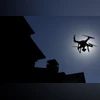 "A drone flies over a neighborhood in Houston, Texas")
The advanced drone swarms in Ukraine showed other European countries that they would also be vulnerable if they failed to quickly ramp up protection, experts said. Days before Russian drones entered Polish airspace, Moscow launched more than 800 exploding drones and decoys across Ukraine, its largest such assault of the war. | Representative mage: Bloomberg
Listen to This Article
Drone swarms that have deluged Ukraine for years — and crossed the border into Poland last week — have sent North Atlantic Treaty Organization (Nato) militaries in Europe rushing to upgrade air defences in case they ever face a similar threat.
Soon they will have a new solution: lasers.
Scientists have for decades sought to harness directed energy beams into weapon systems that would be cheaper and more efficient than missiles or rockets. A growing number of countries are developing or deploying their own laser air defenses, and some have already been used in war, by Israel and Ukraine.
A Nato nation in Europe is now buying an air defence laser from an Australian firm, which officials, experts and industry executives said appears to be the highest-power direct energy system to be sold on the global weapons market. That is a sign that they are becoming more widely available and could be a mainstay for future warfare.
The Australian laser’s maker, Electro Optic Systems, advertises it as able to shoot down 20 drones a minute, at a cost of less than 10 cents per shot. Nicknamed “Apollo” for the Greek god of light, it has about the same level of power as Israel’s highly anticipated Iron Beam air defence laser, which is being built for its own military.
Also Read

 "Donald Trump, Trump")
 "NATO")
 "Nirmala Sitharaman")
 "SL vs AFG")
 "Hindenburg Research, Adani")
“The Ukrainian war and the Gaza war were key trigger events that everybody thought, ‘It’s the time now to make this operational. We should not spend any more years in doing demonstrations, tests and prototyping,’” Andreas Schwer, Electro Optic Systems’ chief executive, said in a recent interview.
“We have some clients which are so much under actual threat that they say, ‘Listen, we can’t wait — we need something tomorrow,” Schwer added. He declined to say which Nato nation is buying the laser.
Air defences have been in high demand for years, particularly to protect targets in the West Asia, East Asia and the US. Houthi fighters in Yemen have long used low-cost drones and cheap cruise missiles against Israel and Saudi Arabia.
The advanced drone swarms in Ukraine showed other European countries that they would also be vulnerable if they failed to quickly ramp up protection, experts said. Days before Russian drones entered Polish airspace, Moscow launched more than 800 exploding drones and decoys across Ukraine, its largest such assault of the war.
For Europe, “the salience, and importance, of this kind of capability has been reinforced by what’s happened in Ukraine,” said Sidharth Kaushal, an expert at the Royal United Services Institute, a military research institution in London.
Wreckage of some of the drones that flew into Polish airspace last week revealed them to be cheap aircraft, nicknamed “Gerbera,” typically made of plywood and Styrofoam. That some of them got past multimillion-dollar Western interceptors highlighted Europe’s potential shortfall against Russia — having too few air defences, which are costly to use, against a barrage of cheap but potentially deadly drones.
The new Australian 100-kilowatt laser is being marketed at about $83 million for each system, including training and spare parts, and will be delivered to its buyer by 2028.
Lasers have drawbacks, and some European defence officials remain skeptical about their effectiveness, which is limited by weather.
Rain, fog and humidity can throw off a laser’s precision, making it harder to hit its target. Most existing laser weapons have a range of a few kilometers and far too little power to stop ballistic missiles.
But it may not be long before high-energy laser weapons are more often used in warfare.
Lasers were first developed in the United States in 1960, and the Pentagon began testing them in weapons within a decade. They use electricity to heat a target with light particles until it melts, ignites or otherwise burns.
The Pentagon spends about $1 billion each year on developing laser weapons, according to a 2023 report by the Government Accountability Office.
More From This Section
 "WHO, World Health Organization")
 "Huawei")
 "US stock market, wall street")
 "River")
 "Donald Trump, Trump")
Topics : NATO weapons Drones Military weapon air defence Ukraine
Don't miss the most important news and views of the day. Get them on our Telegram channel
First Published: Sep 18 2025 | 11:32 PM IST