


TV shows for kids enter golden age in India
As home-grown characters created by local studios dominate the list of top 10 shows, the rules of broadcasting to children are changing
 "Kids television")
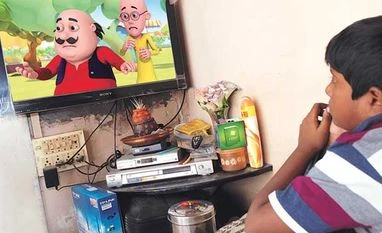
Motu-Patlu: King of Kings, released last week by Viacom18 Motion Pictures, is a fun watch. A bald, pot-bellied Motu gobbles up plateful of samosas just before he gets into a fight with a lion, while friend Patlu eggs him on in their first feature film.
The characters created by Ketan Mehta’s Cosmos Maya debuted on Viacom18’s Nick channel in 2012 and have become rock stars in the world of kids’ entertainment. These characters from Lotpot are, along with Shiva, Krish (of Roll No. 21), Kisna, Mighty Raju and Chhota Bheem, among the many local characters that dominate kids’ television in India.
And they have collectively managed to rewrite the rules of the business of broadcasting to children in the country.
According to the Broadcast Audience Research Council (BARC), of the top ten kids shows on TV, as many as half are based on local characters created by local animation studios in association with Indian or global broadcasters. That is up from none in 2008 and about three in 2011.
“In January (2016), less than two per cent of our schedule was local programming. Now, it is 20 per cent,” says Vijay Subramaniam, head of content, media networks, Disney India.
Between 40 per cent and 55 per cent of the programming on Viacom18 (Nick, Sonic), Turner (Cartoon Network, Pogo) and Discovery Kids is local, homegrown characters. And a bulk of it is in three languages: Hindi, Tamil and Telugu.
These characters are now moving out of TV screens and getting into theatres and onto tiffin boxes, bed sheets and other consumer products. “What has fuelled local characters is an ecosystem that allows monetisation through consumer product licensing rights for digital games, apparel, among other categories,” says Nina Elavaria Jaipuria, business head (kids’ entertainment), Viacom18.
This ecosystem based on intellectual property (IP) ownership is helping break the revenue barriers that kids’ broadcasters usually face.
Kids television gets a 6 per cent share of all TV viewing in India, against 7 per cent for news, making both among the highest watched genres after general entertainment. However, unlike news, which gets a proportionate 7 per cent of the Rs 18,130 crore TV ad revenues, kids’ programming gets just 4 per cent.
“The genre is under-indexed largely because advertisers use it as a tool to reach mothers, who are secondary viewers of kids’ shows, at a lower cost per rating point,” says Anita Nayyar, CEO (India and South Asia), Havas Media.
Local characters such as Shiva and Motu-Patlu have meant that “we have grown 30 per cent year-on-year for two years and also increased our ad rates,” says Jaipuria.
Adding local flavours
Till 2008, it was the dubbed version of Doraemon or Tom and Jerry that dominated the genre. The trigger for the growth of local characters came with Chhota Bheem from Rajiv Chilaka’s Green Gold Animation. It struggled for two years on Turner’s Pogo before becoming the biggest home-grown character not just on kids TV but in Indian entertainment.
One exercise puts Chhota Bheem’s brand value at Rs 400 crore in 2013. In 2008, “making local (content) was tough and expensive at $30,000 per episode for original production and no recovery. Also Indian animation studios were used to doing outsourcing work,” says Anish J S Mehta, CEO, Cosmos Maya.
Inspired by Chhota Bheem, studios such as Maya and Toonz found it worth their while to shift from low-end outsourcing to original shows. This is the first reason kids’ TV has changed.
The second is the texture of this shift. At Rs 20-25 lakh per half-hour, against half or less for a regular TV show, animation is expensive. And it is time consuming. “From the first discussion onwards it took us over 18 months to put Kisna on air,” remembers Rajiv Bakshi, vice-president (female and family entertainment products), Discovery Networks Asia-Pacific (South Asia).
Then there is the time it takes for a show to catch on: Chhota Bheem took two years, Motu-Patlu 18 months. So you need at least a 100 episodes “for any local character to get anywhere,” points out Bakshi.
This long gestation needs working capital. “In 2008,Turner contributed to the costs through co-production, So the credit (for triggering the local character avalanche) goes to them,” says Chilaka.
It is a model that others followed. In kids’ programming, broadcasters and production firms are therefore co-producers, co-financiers and sometimes joint-owners of the IP. This is unusual in India where 80 per cent of TV content is commissioned at rock-bottom rates and all rights are owned by the broadcasters.
And that brings us to the third reason why local characters are having a ball: better contextualisation.“Because the content takes so much time and money, kids’ channels (unlike general entertainment ones) do not offer two to three hours of fresh programming every day. They run on libraries. The child may like a new show. But the true test is how will he react the tenth time he sees it. The success of the show is evident only after the sixth month,” explains Krishna Desai, executive director and network head-kids (South Asia), Turner International India.
“The reason Japanese animation worked is that it was very relatable to Indian kids. Doraemon had Nobita, mom, dad, homework.. It was not just dubbing but the cultural context that helped. Two years ago, local animation (in India) meant only mythologicals. Now you see a lot more local characters,” says Subramaniam.
Shailesh Kapoor, CEO of Ormax Media, a consulting firm, agrees. “What has worked is the context of Indianess: the samosa, the laddoo, what they are called, and how they speak.” Ormax helps broadcasters pre-test shows and concepts.
The big gaps
“We don’t see enough being produced for girls, most of the programming is centered around boys. We did do Sally Bollywood and Maya the Bee. But the viewership is skewed to boys 60:40,” says Bakshi.
This is because in a largely single-TV-home market, girls move faster onto adult general entertainment programming — by the time they are nine or 10.
The other big gap is pre-school programming for kids under 4. This is not considered a serious market by advertisers because BARC measures viewership only among kids that are four and above.
But both these markets and the hope for pay revenues are opening up because of video apps — a hot tool to reach out to kids of all ages. For instance, Viacom18’s app Voot claims great success with kids.

Don't miss the most important news and views of the day. Get them on our Telegram channel
First Published: Oct 17 2016 | 9:41 PM IST