


Buoyant US growth in recent times: Is US President Donald Trump right?
Registering an annualised rate of real GDP growth of 4.3 per cent in Q3 2025, the US economy appeared to have grown at the fastest pace in roughly two years
 "Donald Trump, Trump")
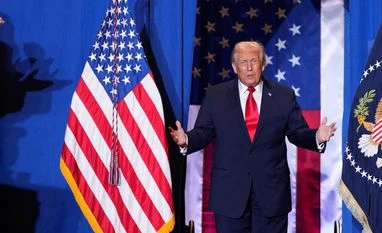
US economy seemed to have temporarily dodged the perils associated with the Trump Tariffs, but it is perhaps still premature to give a final verdict on this issue (Photo:PTI)
Listen to This Article
Much water has flown in the Potomac since the initiation of the tariff war under Trump Presidency 2.0. Admittedly, the dimensions and extent of the tariff war have been varied, experiencing various twists and turns. Interestingly, given the widely accepted superiority of freer trade and the pattern of comparative advantage of the US as a service economy (with little emphasis on commodity production), the expectation was that US growth would be adversely affected. But has it happened? Recent indications are to the contrary.
Registering an annualised rate of real GDP growth of 4.3 per cent in Q3 2025, the US economy appeared to have grown at the fastest pace in roughly two years (Table). While earlier in the year, there was a contraction in Q1 2025, followed by solid rebounds in Q2 and Q3, the US economy seemed to have registered an overall resilient performance.
Component-wise, US growth appeared to be driven by strong consumer spending, exports, and government expenditure, while imports and gross private domestic investment registered negative growth. In fact, forecasting agencies (such as the BlueChip Survey of Professional Forecasters) and international agencies like the IMF expect US real GDP growth to be around 2 per cent in 2025.
Does this indicate the futility of expectations of an adverse impact of tariffs on the US economy? If so, why? Several proximate hypotheses may be put forward.
First, despite the hype, the US economy's exposure to trade has been somewhat limited. According to the St Louis Fed database, the imports (of goods and services) to GDP ratio is around 13.3 per cent for Q3 2025. This relatively low dependence on imports may allow the US to cushion some of the impact of increased tariffs on its domestic economy.
Also Read

 "Venezuela")
 "Reliance")
 "nicolas maduro")
 "Donald Trump, Trump")
Second, to avoid the high tariffs, importers could have front-loaded their imports. As a result, US net exports declined sharply in the first quarter of 2025 and the US economy contracted by 0.3 per cent in the first quarter of 2025. It is possible that, due to this early stockpile of imports and inventory buildup, the impact of the tariff hike on prices is still not showing up in US inflation numbers.
Third, another possibility is that the impact of the tariff hike has not yet been fully passed on, either because exporters have lowered their prices, or importers are absorbing some of the price rise and not passing it on fully to retail customers. In the second case, it still hurts the US economy, as the profit margins of US importers will be squeezed.
Fourth, trade diversion could have mitigated the adverse impact of tariffs to some extent. There are indications that while the US is buying less directly from high-tariff countries like China or India, some firms in these countries are exporting to the US via low-tariff countries as production bases. Early indications suggest that Mexico and Vietnam have emerged as possible tariff winners due to relatively low tariffs and these trade diversions.
But the most intriguing part of the US data has been about consumer spending. High consumer spending, along with massive investments in AI, has powered the US economy in recent times. This increase in consumer spending has come despite a slowing job market and a serious dip in consumer confidence. The University of Michigan's final Index of Consumer Sentiment for December 2025 is 52.9, close to its historical low. Furthermore, there has not been any significant improvement in manufacturing activities, which was one of the most important objectives of the Trump Tariffs.
Interestingly, a more granular look at the data suggests that the growth in consumption has been driven by the top 10 per cent of income earners in the US, who have significantly benefited from a record-breaking stock market boom. The US stock market boom is primarily driven by AI optimism and has pushed the prices of some US companies to unprecedented levels. For example, Nvidia's total market capitalisation crossed $5 trillion in October 2025. To put this number in perspective, the total market capitalisation of all Indian-listed firms is about $5.3 trillion. In fact, the RBI's latest Financial Stability Report (December 2025) has pointed out the global disconnect between elevated economic uncertainty and lower volatility in financial markets. The wealth effect from the stock market boom appears to be driving consumption demand among the richer segment of the US population.
Therefore, the picture is complicated and multi-polar. Tariff-driven inflation is not yet showing up in the US, but as the pre-tariff stockpile disappears, higher import prices are likely to hit the US economy. Consumption and GDP growth have occurred despite the soft job market, indicating growing inequality and social strain. And, possibly more worryingly, there are doubts about whether US firms can profitably monetize the massive investments in AI. If the valuation froth associated with some US companies comes off in 2026, the scenario may take a completely different turn.
Overall, the US economy seemed to have temporarily dodged the perils associated with the Trump Tariffs, but it is perhaps still premature to give a final verdict on this issue.
(Partha Ray is with the National Institute of Bank Management, Pune, and Parthapratim Pal is with the Indian Institute of Management Calcutta, Kolkata.)
(Disclaimer: These are the personal opinions of the writer. They do not reflect the views of www.business-standard.com or the Business Standard newspaper)
More From This Section
 "ultra-processed foods")
 "Dalal Street, BSE")
 "wealth management")
 "media, news")
 "Sindhu Gangadharan")
Don't miss the most important news and views of the day. Get them on our Telegram channel
First Published: Jan 06 2026 | 10:00 AM IST