


Hated by All the Right People: Book traces evolution of Tucker Carlson
From the bow-tied beau ideal of the Washington establishment to the Maga conspiracy theorist-in-chief, Tucker Carlson's biography traces his journey
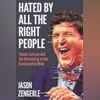 "HATED BY ALL THE RIGHT PEOPLE: Tucker Carlson and the Unravelling of the Conservative Mind")
HATED BY ALL THE RIGHT PEOPLE: Tucker Carlson and the Unravelling of the Conservative Mind
Listen to This Article
HATED BY ALL THE RIGHT PEOPLE: Tucker Carlson and the Unravelling of the Conservative Mind
By Jason Zengerle
Published by Crooked Media Reads
371 pages $28
If you’re looking for an answer to the question “How did we get here?” — from 1990s multiculturalism and free market globalism to ICE raids and Venezuela — you could do worse than using the arc of Tucker Carlson’s career as your lens. And if you’re looking for insight into the right-wing pundit’s transformations, you’ll definitely want to read Jason Zengerle’s breezy, entertaining and ultimately disquieting Hated by All the Right People, a biography of Carlson that tracks his turn from bow-tied beau ideal of the Washington establishment into the Maga-conspiracy-theorist in chief.Also Read

 "G Kishan Reddy, G Kishan")
 "BOOK")
 "helicopter")
 "Ajay Banga, Ajay, Banga")
 "small apartment, flat")
A veteran journalist, Mr Zengerle fills in some aspects on Mr Carlson’s checkered childhood — material privilege offset by his mother’s stunning abandonment when he was eight — but most of the book concentrates on Mr Carlson’s professional life, taking detailed forays into media history and the various ideological cul-de-sacs of the pre-Trump era.
As an intern for the progressive magazine The New Republic in the late 1990s, Mr Carlson drew the admiration of progressives, including Mr Zengerle, for his crackling, witty magazine articles on subjects like the businessman Ross Perot’s dodgy dealings with the Nixon White House. A mediocre student — Mr Zengerle uncovers his 1.9 GPA at Trinity College, which prevented him from graduating — Mr Carlson still managed to talk himself into an early post at The Weekly Standard, becoming a protégé of its founder, Bill Kristol.
Nothing much in these early years distinguished Mr Carlson from mainstream conservatism. Along with colleagues at The Weekly Standard Mr Carlson defended legal immigration against influential eugenicists who wanted to close the border.
There were occasional defections from the Republican Party line. After relentlessly cheerleading the Iraq war, Mr Carlson travelled to Baghdad himself to assess the situation, concluding afterward he’d been duped. He publicly declared that the war had been a mistake in 2004, a position almost singular among conservative pundits.
What ultimately shifted Mr Carlson’s trajectory was his move into TV. In Mr Zengerle’s telling, when Carlson joined the debate show “Crossfire” as its resident conservative in 2001, he found it impossible to maintain either nuance or his contrarian instincts. Instead, he became the sneering partisan hack the show’s format demanded.
Then, in 2004, the comedian Jon Stewart appeared as a guest on the show and accused Mr Carlson of “hurting America.” Shortly thereafter, Mr Carlson lost his position at CNN, where Stewart’s critique evidently struck a chord, and the show itself was cancelled.
Was this a win for American politics? Looking back, Mr Zengerle writes, one can almost feel nostalgia for a show that featured opposing points of view instead of an echo chamber. Even at the time, Mr Carlson was appreciated for his happy warrior vibe. It was this reputation Mr Carlson tried to lean into when he started his next venture, the website The Daily Caller, co-founded in 2010 with the aim, as Mr Zengerle puts it, to focus on “accuracy rather than bombast.”
The Daily Caller made a splash, but not as much as provocative right-wing websites like The Drudge Report or Breitbart News. Watching their success, Mr Carlson observed that readers wanted attacks upon liberals, not informed opinion. The site’s young writers trended towards alt-right ideas on race and immigration, which Mr Carlson slowly absorbed in his pursuit of clicks, hoping to outflank Breitbart and Drudge by tacking even further to the right.
This pursuit of online eyeballs made Mr Carlson receptive, somewhat, to Donald Trump’s unlikely candidacy in 2016. It also made him an ideal bridge between the old and new styles of conservatism. Desperate to attract Mr Trump’s fan base, Fox News turned Mr Carlson into a headliner with a show that would be called Tucker Carlson Tonight, which Fox announced five days before Mr Trump won the 2016 election.
For all his ambivalence about Trump, Mr Carlson realised that the President’s fixation on the show gave him enormous power. Mr Carlson and his guests’ tirades sank the appointments of State Department and UN hopefuls; an interview with the conservative activist Christopher Rufo triggered the White House crusade against critical race theory. Ultimately, not even Fox could kill the monster it had created. Dumped by the network in 2023 as controversies inside and outside the studio mounted, Mr Carlson created his own digital media company, set aside his qualms and fully embraced Mr Trump.
By the dawn of the second Trump term, Mr Carlson’s influence had only increased: He was a key backer of J D Vance for Vice-president and pivotal to the appointments of Robert F Kennedy Jr to health secretary and Tulsi Gabbard to director of national intelligence. So what happened to this guy, the bow-tied brawler once untainted by Republican rage? The whole story resembles a Greek tragedy, with Mr Carlson struggling against a deep-seated character flaw — the desire for attention and fame — and eventually sacrificing everything to that. Along the way, his darkest impulses are nurtured and fanned by a rapidly evolving media landscape. Character meets technology, one might summarise.
Yet it’s not so much a Greek tragedy as a particularly American one. After all, we’re the ones watching, clicking, bingeing on outrage. There was something troubling about Crossfire’s pantomime debates. The audience was left out of the joke: When the combat was over, Mr Carlson and his liberal adversaries, in reality the best of friends, usually went out for a bite afterwards. But the alternative, it turns out, is far worse. Mr Carlson may not have been hurting America then, but surely he is hurting it now.
The reviewer is the author of Milton Friedman: The Last Conservative.©The New York Times News Service
More From This Section
 "book review")
 "Comrades and Comebacks: The Battle of the Left to Win the Indian Mind")
 "Games Hospitals Play: Decoding Your Private Healthcare Experience")
 "THE ELEMENTS OF POWER: A Story of War, Technology, and the Dirtiest Supply Chain on Earth")
 "Tiny experiments: How to live freely in a goal-obsessed world")
Topics : Book Book reading BOOK REVIEW BS Reads
Don't miss the most important news and views of the day. Get them on our Telegram channel
First Published: Feb 02 2026 | 10:38 PM IST